 English
 Spanish

How to pass an anger assessment: compliance made simple

TL;DR:
- Passing an anger assessment requires honesty, self-awareness, and a willingness to grow.
- Verify court-approved programs and prepare thoroughly to meet specific requirements.
- Genuine effort and transparency lead to better outcomes and successful compliance.
You’ve been told you must complete an anger assessment to keep your job, satisfy the court, or meet your probation requirements. That news can feel overwhelming, even unfair. But here’s what most people don’t realize: passing isn’t about pretending you never get angry. It’s about demonstrating awareness, honesty, and a genuine readiness to grow. This guide walks you through exactly what to expect, how to choose the right program, and the specific steps that lead to a valid certificate your court, probation officer, or HR department will accept without question.
Table of Contents
- Understanding anger assessments: what to expect
- Requirements before you start: choosing the right program
- Step-by-step: how to pass your anger assessment
- Common mistakes and how to avoid them
- A new perspective: why ‘passing’ isn’t about having zero anger
- Next steps: get compliant with court-approved anger management
- Frequently asked questions
Key Takeaways
| Point | Details |
|---|---|
| Understand assessment tools | Most anger assessments use standardized tools like STAXI-2 or NAS that measure traits, expression, and control. |
| Choose a compliant program | Verifying your course meets court or employer requirements is crucial for your effort to count. |
| Engage honestly for best results | Transparent, accurate answers ensure you get the right support and a valid certificate. |
| Follow steps for verification | Passing means full participation, meeting quiz thresholds, and obtaining an accepted certificate. |
Understanding anger assessments: what to expect
Think of an anger assessment like a check engine light on your dashboard. It isn’t there to punish you. It’s there to give a trained evaluator a clear picture of where you are emotionally so they can match you with the right level of support. Having previewed the importance of these assessments, let’s clarify what the process actually involves and what judges, evaluators, or HR departments look for.
Common assessment tools
Anger assessments typically use tools like the STAXI-2 (State-Trait Anger Expression Inventory-2) and NAS (Novaco Anger Scale). You can learn more about what the STAXI-2 test measures in terms of emotional intensity and behavioral responses. MasteringAnger.com also uses the Conover Assessment, a standardized screening tool designed to measure impulse control and recommend the appropriate course length.
Here is a quick overview of what each tool measures:
| Tool | What it measures | Format |
|---|---|---|
| STAXI-2 | State anger, trait anger, expression, control | Self-report questionnaire |
| NAS | Anger intensity, cognitive and behavioral dimensions | Self-report + interview |
| Conover Assessment | Impulse control, anger risk level | Standardized online screening |
What ‘passing’ actually means
There is no universal pass score on these tools. High T-scores above 70 indicate elevated anger, but a high score doesn’t automatically mean failure. What evaluators want to see is self-awareness, honest engagement, and a willingness to change. Passing means meeting the benchmarks your specific court order or HR requirement sets, not hitting a magic number.
Why honesty matters more than you think
Some people try to minimize their answers, thinking lower scores look better. This is one of the biggest mistakes you can make. These tools include validity scales specifically designed to detect inconsistent or faked responses. If you appear to be minimizing, evaluators flag it. That can extend your probation or delay your compliance timeline.
“The goal of an anger assessment isn’t to label you. It’s to understand you well enough to help you.”
For those involved in domestic violence cases, note that you may be referred to a Batterer Intervention Program rather than a standard anger management course. These are separate programs with different requirements, so always verify court acceptance criteria before you enroll in anything.
Requirements before you start: choosing the right program
Now that you know what the assessment looks for, it’s time to make sure you choose a program that actually fulfills those requirements. Enrolling in the wrong course is one of the most common and costly mistakes mandated individuals make.
Verify before you enroll
Before signing up for any program, contact your court, probation officer, or HR department and ask specifically which providers or formats they accept. Not all online courses carry the same weight. Some courts require in-person attendance. Others accept online program options that are fully self-paced. Getting verbal confirmation is good. Getting written confirmation is better.
Program format comparison
| Format | Pros | Cons |
|---|---|---|
| Online self-paced | Flexible, accessible, often lower cost | Must confirm court acceptance |
| In-person | Widely accepted, group accountability | Scheduling constraints, travel required |
| Hybrid | Balance of both | Varies by provider |
Research consistently shows that online CBT-based (Cognitive Behavioral Therapy) programs are as effective as in-person options for building anger management skills and meeting compliance requirements.
Pro Tip: Ask your provider for a sample certificate before enrolling. A legitimate program will show you exactly what documentation they issue, including credentials, course hours, and company verification information.
Your pre-enrollment checklist
Before you commit to any program, make sure it checks every box below:
- Provides a certificate of completion accepted by your specific court or employer
- Lists the provider’s credentials clearly (licensed clinician, company name, EIN)
- Specifies pass or fail criteria in advance
- Offers documentation that courts and HR departments can independently verify
- Matches the course length your court order specifies
Learning how to complete court-ordered anger management correctly from the start saves you from having to repeat the process. It also gives you the best chance of satisfying your requirements on the first attempt. Take time now to choose a court-approved course that fits your specific mandate.
Step-by-step: how to pass your anger assessment
After you’ve enrolled in an approved program, here’s how to make sure you actually pass, from your first login to your certificate in hand.
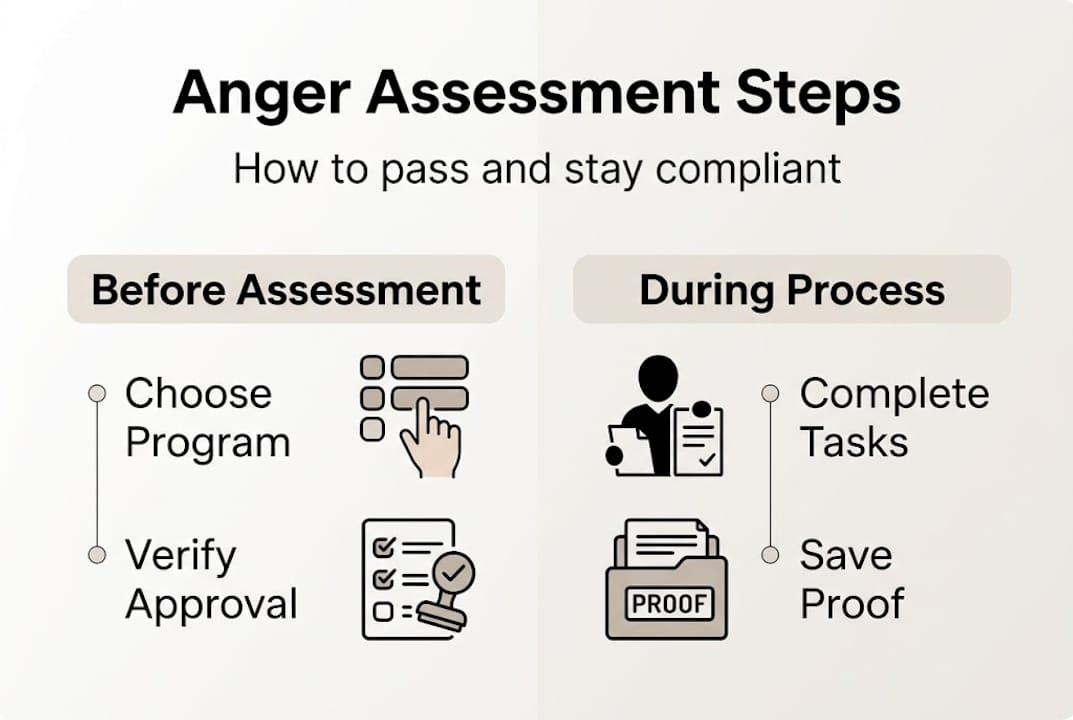
- Enroll in an approved course. Confirm with your court or employer that the specific program you’ve chosen meets their requirements. Save that confirmation in writing.
- Complete the initial assessment honestly. Your answers shape which course length and support level you receive. Accurate responses lead to a program that actually fits your needs.
- Engage with every module. Don’t skip ahead or rush through content. Evaluators and program administrators track participation, not just quiz scores.
- Achieve passing quiz scores. Most programs require a score of 40% or higher on module quizzes, though thresholds vary. Review material and retake quizzes if needed.
- Participate in exercises and discussions. Written reflections, interactive exercises, and discussion prompts are part of demonstrating behavioral engagement, which is just as important as raw quiz performance.
- Obtain your certificate. Once all requirements are met, your provider issues a verifiable certificate. Confirm it includes course hours, provider credentials, and contact information.
Programs built around CBT effectiveness reduce anger-related incidents by 50 to 70 percent when participants genuinely engage with the curriculum. That’s not just a compliance win. It’s a real-life improvement.
Passing means demonstrating progress, not perfection. Show up fully for every step.
Following the step-by-step compliance guide keeps you organized and on track throughout the process.
Pro Tip: Save every confirmation email, login timestamp, quiz result, and certificate you receive. If your court or employer ever questions your completion, this paper trail is your best defense.

For a closer look at program options by length and format, reviewing course comparisons can help you match the right program to your mandate.
Common mistakes and how to avoid them
Successfully following the steps is crucial, but so is avoiding the pitfalls that lead many people to fail or repeat the process. These mistakes are more common than you’d think, and they’re almost always avoidable.
Top mistakes mandated individuals make
- Minimizing or faking answers on the initial assessment, which triggers validity flags and can extend your requirements
- Skipping modules or rushing through them without genuine engagement
- Enrolling in an unapproved program that the court or employer won’t accept
- Leaving quizzes incomplete or failing to meet the minimum score threshold
- Losing or not requesting documentation such as your certificate, provider letter, or completion report
- Missing deadlines without communicating proactively with your court or HR contact
“Evaluators can detect faked responses. Honesty leads to the best legal and personal outcome every time.”
This isn’t just good advice. Honesty is essential because evaluators are trained to spot minimization, and faking low anger can result in extended probation or repeated requirements.
What to do if you make a mistake
If you realize you rushed through a module or gave inaccurate answers, don’t panic. Contact your program provider right away. Most providers allow you to retake quizzes or clarify responses before your certificate is issued. If you enrolled in the wrong program, reach out to your court or HR contact immediately and ask about approved alternatives. Proactive communication almost always produces a better outcome than silence.
For employees navigating workplace requirements, reviewing employee compliance advice offers targeted guidance for HR-mandated situations. You can also review the legal requirements tips that apply specifically to court-ordered participants. And when selecting a provider, make sure to look only at court-accepted programs to avoid wasted effort.
A new perspective: why ‘passing’ isn’t about having zero anger
Recognizing and learning from common mistakes brings us to a crucial mindset shift for anyone facing an anger assessment. Here’s what we’ve seen after years of working with thousands of mandated clients: the people who struggle most are those who treat the assessment as a test to beat rather than a tool to use.
Anger is not the enemy. It’s a signal, like a guard protecting something you care about. The assessment is designed to measure whether you can recognize that signal, understand what triggers it, and respond in a way that doesn’t harm you or anyone else.
Evaluators aren’t looking for someone with zero anger. They’re looking for honesty, insight, and a real commitment to change. When you approach the process with transparency, something important happens: the program you’re matched with actually fits your needs. That means better outcomes, faster compliance, and real behavioral progress that holds up over time.
Honesty over minimization leads to better outcomes and genuine improvement. We’ve seen it consistently. The people who engage fully, even imperfectly, walk away with skills that make a measurable difference in their relationships and daily lives. The impact of court-accepted programs goes far beyond a piece of paper when participants bring genuine effort to the process.
Next steps: get compliant with court-approved anger management
With the right mindset, the final step is taking action on your path to compliance. MasteringAnger.com has been helping mandated clients meet court, probation, and HR requirements since 2009. Our evidence-based courses are built on clinical curriculum developed by Dr. Carlos Todd, PhD, LCMHC, and our certificates are accepted by courts and employers across the United States.
Whether you need Arizona anger management classes, Washington anger management courses, or a program in your state, we have a verified, court-approved option ready for you. Not sure where to start? Get started with an anger evaluation to determine the right course length for your specific mandate. Your certificate, your compliance, and your peace of mind are within reach today.
Frequently asked questions
What is a passing score on an anger assessment?
There is no universal pass score; passing usually means meeting your program’s specific requirements and demonstrating meaningful engagement and progress throughout the course.
Can I fail an anger assessment if I answer honestly?
Honest answers may lead to more sessions being recommended, not failure. Evaluators value truth and use your results to match you with the right level of support, and faking can result in extended probation or flagged responses.
How do I know if a program is court-approved?
Always check with your court, probation officer, or HR department before enrolling, and enroll in compliant programs whose credentials, certificates, and provider information can be independently verified.
Are online anger management courses valid for mandated assessments?
Yes. Many courts and employers accept online CBT-based programs, and online programs are effective as in-person options for compliance when the provider is properly credentialed.
What if I make a mistake in my anger assessment or course?
Be honest and communicate with your provider or court right away. Most programs allow you to retake quizzes or clarify answers before your certificate is issued, so acting quickly is key.
Recommended
- Step by Step Anger Management Class for Court Compliance
- How to Complete Court Ordered Anger Management Online
- Why courts accept anger management: ensuring compliance
- Online anger management: evidence, compliance, and results
- How to Calm Racing Thoughts — The Caia Journal
Dr. Carlos Todd PhD LCMHC specializes in anger management, family conflict resolution, marital and premarital conflict resolution. His extensive knowledge in the field of anger management may enable you to use his tested methods to deal with your anger issues.


Responses