 English
 Spanish

Online anger management: evidence, compliance, and results

Online anger management courses carry a reputation they don’t deserve. Many people assume that only in-person classes count for court orders, probation, or employer mandates, but that assumption can cost you time, money, and peace of mind. RCTs confirm that online interventions measurably reduce anger, hostile bias, and aggressive behaviors. This article walks you through the science behind online programs, how to verify legal acceptance, how online and in-person formats compare, and how to decide which path fits your situation. By the end, you’ll have a clear framework for choosing a program that actually works and holds up to scrutiny.
Key Takeaways
| Point | Details |
|---|---|
| Online courses are effective | RCTs and meta-analyses confirm online anger management reduces anger and aggressive behaviors. |
| Compliance depends on accreditation | Verify your provider’s credentials to ensure acceptance for legal or workplace requirements. |
| Convenience with flexibility | Online programs allow self-paced learning and certificate delivery without travel or scheduling hassles. |
| Know your eligibility | Online courses are ideal for moderate cases but not severe anger requiring therapist intervention. |
| Choose reviewed providers | Selecting licensed, reviewed platforms ensures both effectiveness and verified compliance. |
What makes online anger management effective?
Skepticism about online anger management is understandable. It can feel like a lesser option, something you do on a laptop instead of sitting across from a real counselor. But the research tells a different story.
RCTs and meta-analyses consistently show that structured online anger management programs reduce both state anger (how angry you feel right now) and trait anger (how anger-prone you are over time). They also lower hostile thinking patterns and aggressive behaviors. These aren’t minor shifts. They’re the same outcomes courts and employers care about.
The strategies that drive these results include:
- Cognitive reappraisal: Learning to reinterpret triggering situations so they feel less threatening
- Acceptance techniques: Acknowledging anger without acting on it impulsively
- Impulse control training: Building a pause between feeling and reacting
- Conflict resolution skills: Replacing reactive patterns with constructive communication
Think of it like a car’s dashboard warning light. Anger is the signal. A good program teaches you to read that signal clearly instead of ignoring it or slamming the accelerator.
“Structured online programs using evidence-based strategies produce outcomes comparable to traditional in-person anger management when delivered by accredited providers.”
The key phrase there is accredited providers. Not every online course is created equal. A program built on a clinician’s validated curriculum, like the one at MasteringAnger.com, carries far more weight than a generic self-help video series. If you want to understand step-by-step compliance requirements before you enroll, reviewing that process first will save you from surprises later.
The bottom line: effectiveness isn’t about the room you’re sitting in. It’s about the quality of the curriculum and the credentials behind it.
Legal compliance: How to ensure your online course is accepted
Effectiveness matters, but if your certificate gets rejected by a judge or probation officer, none of it helps. Legal acceptance is the first thing you should verify, not the last.
Verify acceptance before enrolling because not all courts accept online courses, and requirements vary significantly by jurisdiction. What works in one county may not satisfy a judge in another state.
Here’s what to look for when evaluating a provider:
- Licensed clinician oversight: The program should be designed and supervised by a credentialed mental health professional.
- Verifiable credentials: The provider should supply their license number, company EIN, and contact information on the certificate.
- Assessment documentation: Courts often want proof that the course length was matched to your assessed risk level.
- Clear certificate format: The certificate should list course hours, completion date, provider name, and credentials.
- Jurisdiction-specific language: Some providers can confirm acceptance in your state or county before you pay.
| Typical court requirement | What a reliable online course offers |
|---|---|
| Licensed provider | Clinician-owned and operated program |
| Verified certificate | PDF with EIN, credentials, and hours |
| Appropriate course length | Assessment-based length recommendation |
| State-specific approval | Jurisdiction verification available |
| Contact for confirmation | Direct provider contact information |
Pro Tip: Before you enroll anywhere, call or email your probation officer, attorney, or HR department and ask specifically whether online courses are accepted and what documentation they require. Get that answer in writing if you can.
For a side-by-side look at your options, the course comparison guide breaks down what different programs include. You can also review guidance on choosing court-accepted courses to understand what red flags to watch for.
Comparing online vs. in-person anger management
Once you know your compliance requirements, the next question is practical: which format actually serves you better?
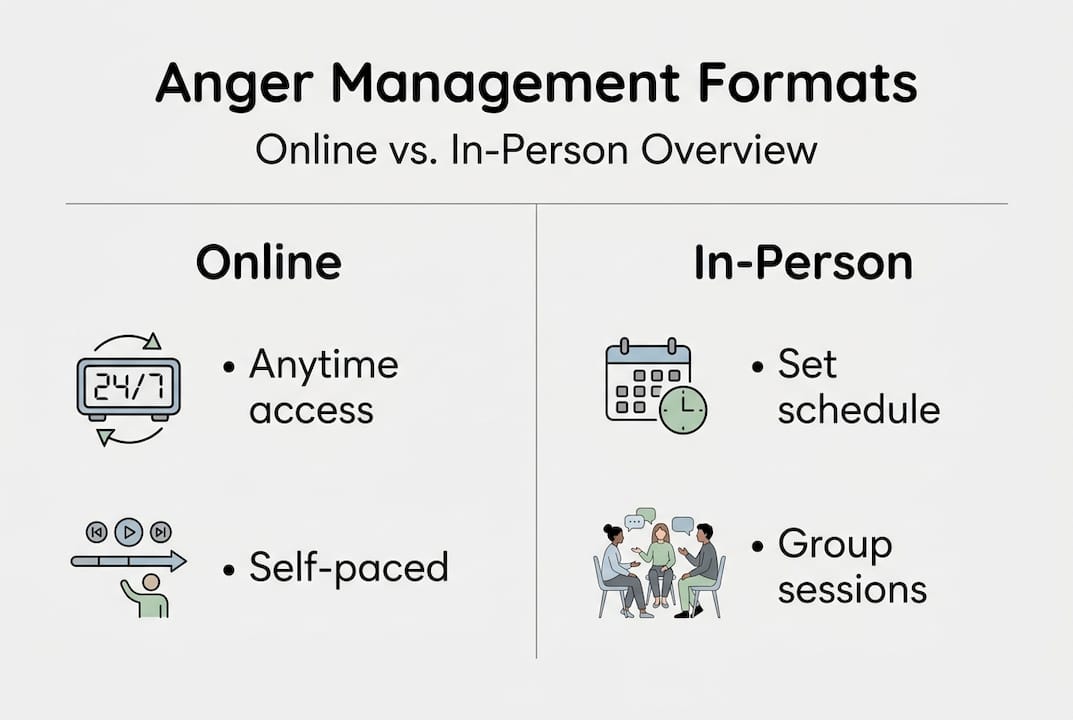
Meta-analyses show equivalence in many outcomes between online and in-person anger management programs. There is no clear evidence that sitting in a room with a counselor produces better results than a well-structured online course. That’s a finding worth sitting with, because it runs counter to what most people assume.

| Factor | Online | In-person |
|---|---|---|
| Scheduling flexibility | Complete at your own pace | Fixed appointment times |
| Geographic access | Available anywhere with internet | Limited to local providers |
| Cost | Generally lower | Often higher due to overhead |
| Certificate validity | Accepted when accredited | Widely accepted |
| Live interaction | Typically asynchronous | Real-time with counselor |
| Privacy | High, done from home | Less private setting |
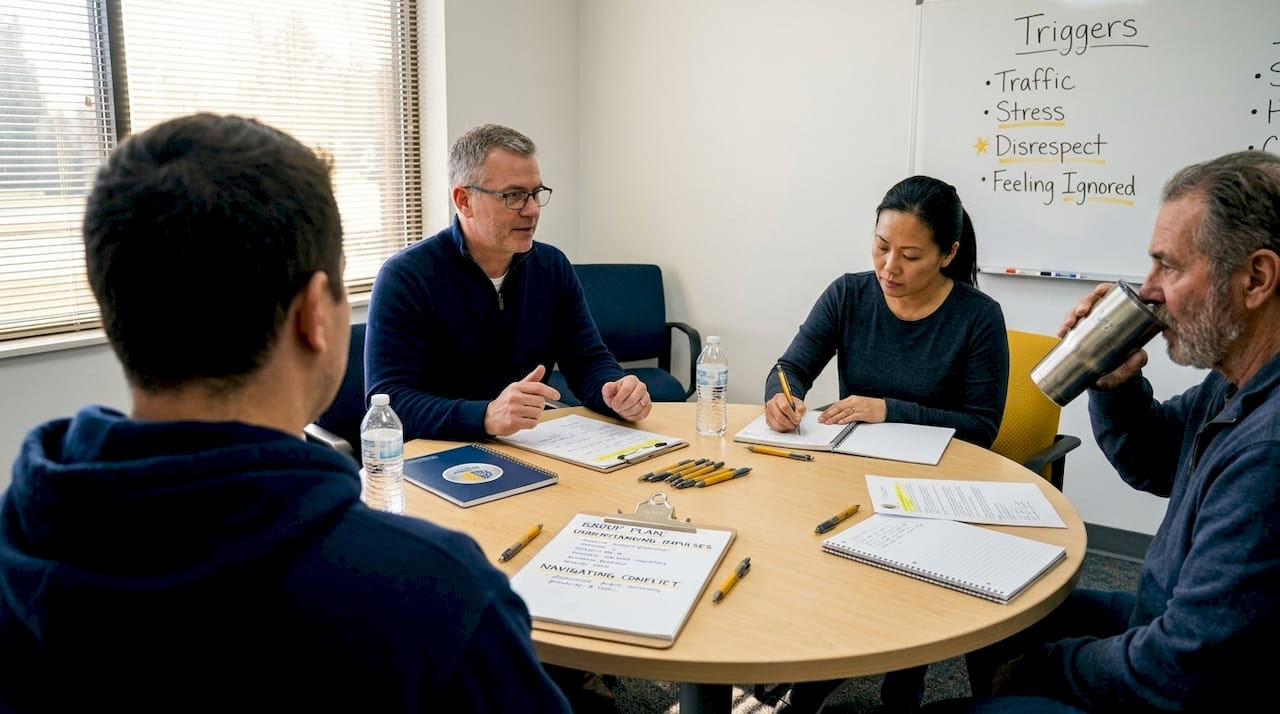
In-person programs do offer one thing online courses can’t fully replicate: live, real-time interaction with a counselor. For some people, that human presence is motivating. For others, it’s a barrier because of scheduling, transportation, or the discomfort of a group setting.
Online programs shine in flexibility and accessibility. You can complete coursework at midnight if that’s when you have time. You’re not dependent on a local provider’s availability. And for many people dealing with the stress of a legal situation, being able to work through material privately at home reduces anxiety and increases engagement.
“Accredited online programs are viewed by many courts and employers as equally valid to in-person classes, provided the provider credentials are verifiable.”
The benefits of online programs include:
- No commuting or scheduling conflicts
- Immediate enrollment and certificate delivery
- Consistent curriculum quality regardless of location
- Documentation that courts and HR departments can independently verify
For a deeper look at what makes a program legally solid, the guide on court-accepted programs covers the specific markers that matter to legal authorities.
Who should (and shouldn’t) choose online anger management?
Online anger management isn’t the right fit for everyone, and being honest about that is part of giving you genuinely useful guidance.
Online programs work well for people who:
- Need to fulfill a court order, probation requirement, or employer mandate
- Have moderate anger issues and want structured skill-building
- Prefer a self-paced format they can complete around work and family
- Live in areas without convenient access to in-person providers
- Want a private, low-pressure environment to work through material
Online programs are unsuitable for individuals with severe anger, a history of violence, or those who need live therapeutic intervention. If your situation involves ongoing threats, active domestic violence, or a mental health condition that requires clinical management, an online course is not a substitute for in-person therapy or a structured treatment program.
It’s also worth noting that self-paced formats lack the real-time accountability that some people need to stay engaged. If you know you tend to procrastinate or need external structure to follow through, factor that into your decision.
Pro Tip: Always verify jurisdictional acceptance before you enroll. Contact the court clerk, your probation officer, or your HR department directly. Don’t rely on a provider’s general claim that their course is “court-accepted” without confirming it applies to your specific situation.
For guidance on what the process looks like from start to finish, the resource on completing court-ordered classes walks through each step clearly.
Lessons learned: What most guides miss about online anger management
Most articles about online anger management focus on whether it works. Fewer address the more practical question: whether it will work for your specific compliance situation.
Conventional wisdom still undervalues online programs for legal compliance. People assume that courts want in-person attendance because that’s how it used to work. But the landscape has shifted, and many jurisdictions now accept accredited online courses without hesitation.
What separates a program that gets accepted from one that gets rejected isn’t the format. It’s the credentials behind it. A course designed by a licensed mental health counselor, backed by standardized assessments, and issued with verifiable documentation carries real weight. A generic online video series does not.
Top-reviewed providers for U.S. compliance needs include clinician-led platforms with documented track records. That distinction matters enormously when a judge or probation officer is reviewing your paperwork.
For a current look at how online programs are meeting court mandates in 2026, the mandated program perspectives resource offers useful context. The takeaway is simple: prioritize evidence-based platforms with verifiable credentials, and the format becomes secondary.
Find trusted online anger management solutions
If you’ve read this far, you’re serious about finding a program that holds up. That’s exactly the mindset that leads to a successful outcome.
MasteringAnger.com, operated by Dr. Carlos Todd, PhD, LCMHC, has been serving court-ordered clients, probation participants, and employees across the U.S. since 2009. Every program is clinician-designed, assessment-based, and backed by verifiable documentation that courts, attorneys, and HR departments can independently confirm. Whether you need Arizona anger classes, Michigan anger classes, or a program in another state, the platform offers flexible course lengths from 4 to 52 hours. Visit MasteringAnger.com to enroll, complete your assessment, and receive your certificate without delay.
Frequently asked questions
Are online anger management courses accepted by U.S. courts?
Many courts accept accredited online anger management courses, but acceptance varies by jurisdiction, so confirm with your specific court or probation officer before enrolling.
How effective are online anger management programs compared to in-person classes?
Meta-analyses confirm equivalence in outcomes between accredited online and in-person programs, meaning format alone doesn’t determine results.
Can I get a verified certificate from an online anger management course?
Yes. Reputable providers like clinician-led platforms issue certificates with provider credentials, course hours, and verifiable contact information suitable for court and employment compliance.
Who should not use online anger management classes?
Individuals with severe anger, a violence history, or those requiring live clinical intervention should choose in-person services, as self-paced formats lack the real-time therapeutic support those situations demand.
Recommended
- Online anger management programs for court mandates 2026
- Anger Management for Professionals: Compliance Solutions
- Anger Management in the Workplace Explained: Compliance and Impact
- 7 Key Features of Verified Anger Management Courses
Dr. Carlos Todd PhD LCMHC specializes in anger management, family conflict resolution, marital and premarital conflict resolution. His extensive knowledge in the field of anger management may enable you to use his tested methods to deal with your anger issues.

Responses