 English
 Spanish

Online anger management programs for court mandates 2026

Adults mandated to complete anger management often discover too late that their chosen online program doesn’t meet court requirements. Many courts across the U.S. accept online anger management classes if provided by licensed professionals with proper documentation, but verification before enrollment prevents costly rejections. This guide explains how to identify court-approved programs, understand psychological assessments, and ensure your certificate satisfies legal mandates.
Key takeaways
| Point | Details |
|---|---|
| Court acceptance depends on verification | Only programs led by licensed mental health professionals with evidence-based curricula meet most court standards. |
| Assessments personalize treatment length | Psychological screening tools like the Conover Assessment determine optimal course hours, reducing recidivism by up to 50%. |
| Documentation quality is critical | Certificates must include provider credentials, EIN, course hours, and assessment basis or risk rejection. |
| Online programs match in-person effectiveness | Research shows 50-70% reduction in anger outbursts with comparable outcomes to traditional formats. |
| Pre-enrollment verification prevents penalties | Confirming court acceptance before starting saves time, money, and legal consequences. |
Understanding court-mandated anger management and online acceptance
Court-mandated anger management is a legal requirement imposed on adults whose behavior led to criminal charges, workplace discipline, or family court proceedings. The mandate obligates you to complete structured education designed to address anger-related issues and reduce future incidents. Courts use this intervention as rehabilitation rather than punishment alone.
The acceptance of online anger management programs has grown significantly across U.S. jurisdictions. Courts now recognize that technology allows effective clinical intervention without requiring physical attendance. However, acceptance isn’t universal or automatic.
Courts evaluate programs based on specific criteria:
- Licensed mental health professionals must design and oversee curriculum
- Evidence-based methods rooted in psychological research
- Verifiable completion documentation with provider credentials
- Proper assessment protocols to match course length with individual needs
- Clear contact information for independent verification
Instruction by licensed mental health professionals significantly increases both court acceptance and clinical effectiveness. Programs led by coaches or unlicensed facilitators face routine rejection. Your probation officer or attorney can confirm specific requirements in your jurisdiction before you enroll.
Pro Tip: Always obtain written confirmation from your court or probation officer that they accept online programs before paying for any course. Verbal approval isn’t sufficient if disputes arise later.
How psychological assessments tailor anger management program lengths
Psychological assessments form the clinical foundation for determining appropriate course length and intensity. Licensed providers use standardized screening tools to measure anger severity, impulse control patterns, and risk factors that influence treatment needs. The Conover Assessment is one widely used instrument that evaluates emotional regulation and conflict response.
These assessments generate objective data that guides clinicians in recommending course lengths ranging from 4 hours for minor incidents to 52 hours for severe cases. Someone arrested for a first-time verbal altercation might complete an 8-hour course, while domestic violence cases often require 24 to 52 hours of structured intervention.
Research demonstrates that tailored programs based on clinical assessment can reduce violent recidivism by up to 50% compared to one-size-fits-all approaches. This personalization addresses your specific triggers, thought patterns, and behavioral responses rather than generic anger content.
Typical course length assignments include:
- 4-8 hours: Minor workplace conflicts or first-time incidents
- 12-16 hours: Repeated anger issues or moderate risk assessments
- 24-36 hours: Domestic situations or elevated impulse control concerns
- 52 hours: Serious violence history or high-risk clinical profiles
Your assessment results also influence curriculum focus areas. High scores in specific categories like verbal aggression or physical intimidation trigger additional modules addressing those patterns. Courts reviewing properly assessed programs recognize the clinical rigor and accept certificates more readily.

Pro Tip: Answer assessment questions honestly rather than minimizing issues. Inaccurate responses lead to inappropriate course assignments that courts may reject as insufficient for your case severity.
Exploring court accepted anger management programs helps you understand the full spectrum of options that meet legal requirements.
Effectiveness evidence for online anger management programs
Clinical research and provider data confirm that accredited online anger management programs produce measurable behavior improvements. Studies tracking participants report 50-70% reduction in anger outbursts following program completion. These outcomes match or exceed traditional in-person formats when licensed clinicians design the curriculum.
Providers consistently observe improvements beyond just anger reduction:
- Enhanced communication skills during conflicts
- Better recognition of anger triggers before escalation
- Increased use of timeout and cooling-off strategies
- Improved problem-solving without verbal or physical aggression
- Stronger awareness of consequences before reacting
Online course completion rates generally exceed in-person classes. The flexibility to complete modules on your schedule reduces dropout from scheduling conflicts or transportation barriers. Higher completion rates translate to better legal compliance and personal growth.
Concerns about online training gaps dissolve when examining accredited programs. Licensed clinicians create content, review responses to reflection exercises, and monitor progress throughout the course. You’re not simply watching videos but engaging with evidence-based therapeutic frameworks.
“Programs led by licensed professionals with psychological assessment protocols demonstrate clinical effectiveness comparable to traditional therapy settings while offering greater accessibility for mandated participants.”
Courts increasingly recognize this evidence when reviewing certificates from established online providers. The key differentiator remains clinical oversight rather than delivery format. A 24-hour online course with licensed clinician involvement outperforms a 24-hour workshop led by unlicensed facilitators.
Your certificate’s acceptance ultimately depends on the provider’s credentials and documentation quality, not whether you sat in a physical classroom. Focus on verification of licensing rather than format alone.
Documentation and verification: what courts require for compliance
Proper documentation separates accepted certificates from rejected submissions that trigger legal consequences. Courts and employers require specific information to verify legitimate program completion and prevent fraud.
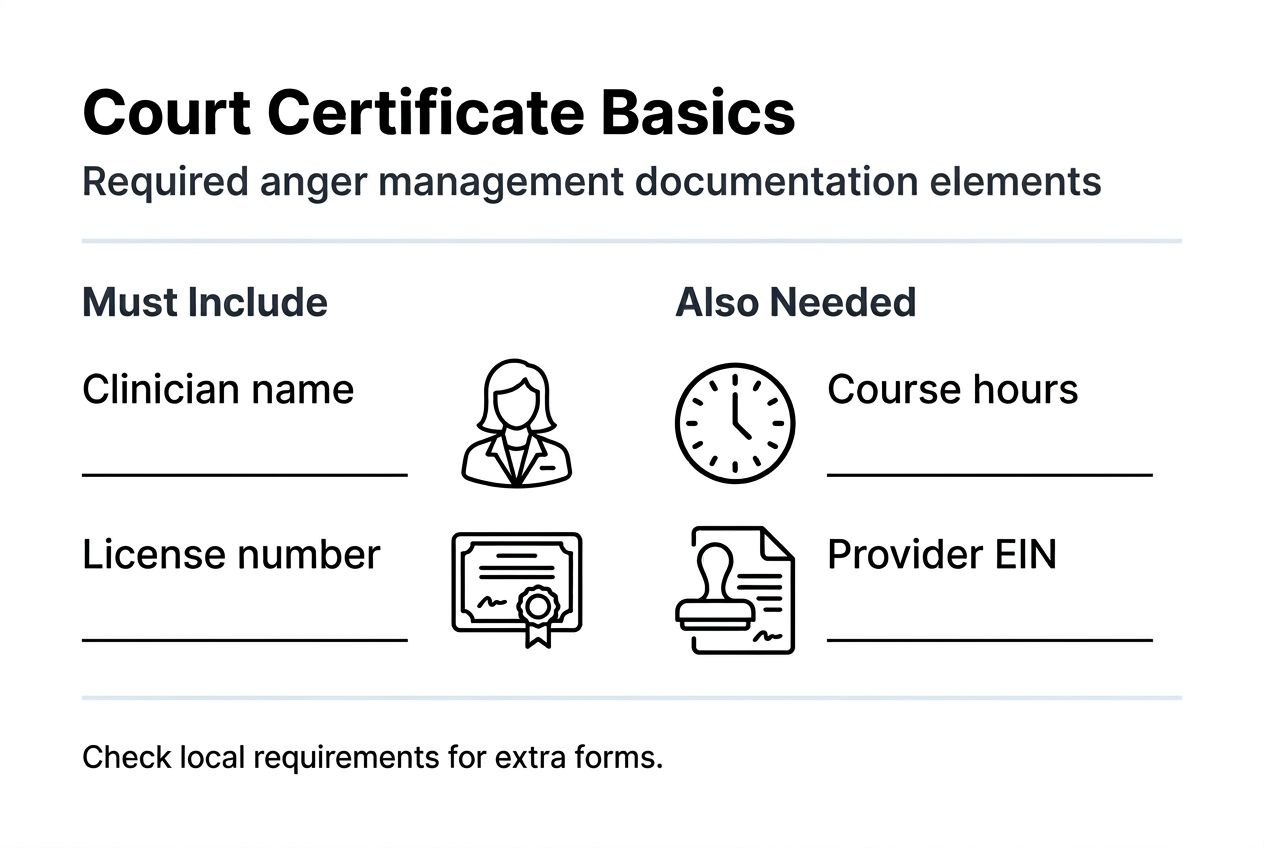
Your completion certificate must include:
- Provider’s full legal business name and contact information
- Licensed clinician’s name, credentials, and license number
- Company EIN for independent verification
- Total course hours completed
- Psychological assessment basis for course length
- Completion date
- Participant’s full legal name
Incomplete or generic certificates lacking these elements face routine rejection. Missing a licensed clinician’s name suggests unlicensed instruction. Absent EIN information prevents courts from verifying the provider’s legitimacy. Insufficient course hour documentation creates questions about whether you met mandate requirements.
Rejected certificates create serious legal setbacks. You may face contempt of court charges, extended probation, additional fines, or even jail time for non-compliance. The financial cost of redoing an entire program pales compared to these penalties.
Common documentation errors include:
- Certificates from coaching programs without licensed mental health oversight
- Missing assessment documentation showing clinical basis for hours
- Providers using personal names instead of registered business entities
- Incomplete contact information preventing verification calls
- Generic templates without customized participant details
Before submitting your certificate, verify it contains all mandated elements. Contact the provider immediately if information is missing rather than hoping courts won’t notice. Proactive correction prevents rejection and demonstrates good faith compliance.
Some jurisdictions require additional provider letters or completion reports beyond basic certificates. Clarify these requirements early so your provider can prepare complete documentation packages.
Comparing online vs. in-person anger management programs
Understanding format differences helps you choose the right program for your situation and court requirements. Both online and in-person programs can meet legal mandates when properly accredited.
| Feature | Online Programs | In-Person Programs |
|---|---|---|
| Flexibility | Complete on your schedule, 24/7 access | Fixed class times, often evenings/weekends |
| Privacy | Anonymous participation from home | Group settings with other participants |
| Completion rates | Generally higher due to scheduling flexibility | Lower due to attendance barriers |
| Licensed oversight | Clinician-designed curriculum with monitored progress | Direct therapist interaction during sessions |
| Court acceptance | Widely accepted with proper credentials | Universally accepted when accredited |
| Cost | Typically lower without facility overhead | Higher due to venue and staffing costs |
Online advantages include eliminating transportation barriers, avoiding schedule conflicts with work, and maintaining privacy about your legal situation. You complete modules during lunch breaks, late nights, or weekends without coordinating with group meeting times. Higher completion rates reflect these practical benefits.
In-person benefits center on immediate therapist feedback and group dynamics. Direct interaction allows real-time processing of emotional reactions and peer support from others facing similar challenges. Some people respond better to structured, scheduled sessions than self-paced online learning.
Courts accept both formats when programs meet accreditation standards, though specific cases may mandate in-person attendance. Domestic violence situations sometimes require face-to-face sessions based on case severity or judicial preference. High-risk assessments might similarly trigger in-person requirements.
Completion data favors online programs for working adults with family responsibilities. The flexibility prevents dropouts from childcare emergencies, shift work changes, or transportation breakdowns. However, individuals who struggle with self-discipline may benefit from the external structure of scheduled classes.
Pro Tip: If your court order doesn’t specify format, choose based on your learning style and schedule constraints rather than assumptions about one being “better.” Both work when you engage genuinely with the material.
Common misconceptions about court-mandated online anger management
Misunderstandings about online anger management create unnecessary barriers and legal risks. Clearing up these myths helps you make informed decisions.
Myth: Any online certificate satisfies court requirements regardless of provider credentials. Fact: Courts accept only certificates from licensed mental health professionals with verifiable credentials and proper documentation. Unlicensed programs face automatic rejection.
Myth: Online programs lack clinical rigor compared to in-person classes. Fact: Accredited online programs use the same evidence-based curricula as traditional formats, with licensed clinicians designing content and monitoring progress throughout.
Myth: Anger management is punishment rather than rehabilitation. Fact: Court-mandated programs aim to reduce recidivism through skill-building, not punishment. You learn practical anger control strategies that improve relationships and reduce legal problems.
Myth: Cheaper programs work just as well as established providers. Fact: Extremely low-cost programs often lack licensed oversight, proper assessments, or acceptable documentation. Rejected certificates force you to pay twice while facing legal consequences.
Myth: You can complete mandated hours faster by taking shortcuts. Fact: Legitimate programs require full engagement with all modules, reflections, and assessments. Rushed completion without genuine learning leads to recidivism and potential additional legal requirements.
The most dangerous misconception is that format matters more than accreditation. Courts care about licensed clinical oversight, evidence-based methods, and verifiable documentation. An online program meeting these standards outperforms an in-person workshop lacking them.
Ignoring compliance requirements or enrolling in unapproved programs creates serious legal risks. Contempt findings, extended probation, and incarceration result from certificate rejection. Verify approval before starting rather than hoping for acceptance after completion.
Navigating successful completion and avoiding legal risks
Following systematic steps ensures you meet mandate requirements without legal complications or wasted time and money.
- Confirm your court or employer specifically accepts online anger management before researching programs. Obtain this approval in writing from your probation officer, attorney, or HR representative.
- Choose an accredited program led by licensed mental health professionals. Verify the provider’s credentials, business registration, and track record of court acceptance in your jurisdiction.
- Complete the required psychological assessment honestly and thoroughly. This screening determines appropriate course length and ensures your certificate reflects clinical justification for the hours assigned.
- Finish all course modules, quizzes, reflections, and final assessments within required timeframes. Engage genuinely with material rather than rushing through to check boxes.
- Obtain your completion certificate with full verification details including provider credentials, EIN, course hours, assessment basis, and completion date. Review carefully for accuracy and completeness.
- Submit documentation to relevant authorities by your deadline. Keep copies of everything submitted and obtain proof of receipt to protect against lost paperwork claims.
Pro Tip: Set calendar reminders for interim deadlines throughout your course rather than waiting until the final due date. Last-minute technical issues or incomplete modules create avoidable legal problems.
Understanding how to complete court ordered anger management provides additional guidance on avoiding common pitfalls. Following step by step anger management class compliance protocols ensures you satisfy every requirement systematically.
Maintain communication with your probation officer or attorney throughout the process. Notify them immediately if unexpected issues arise rather than missing deadlines silently. Courts appreciate proactive communication about genuine obstacles versus excuses after the fact.
Explore verified online anger management classes
Meeting your court mandate requires choosing programs with proven acceptance records and proper clinical oversight. MasteringAnger.com offers comprehensive online courses led by Dr. Carlos Todd, PhD, LCMHC, a licensed mental health counselor specializing in anger management and conflict resolution since 2009.
Our programs include psychological assessments using standardized tools to determine appropriate course length for your specific situation. You’ll receive certificates containing all required documentation elements courts and employers need for verification. Course lengths range from 4 to 52 hours, matching assessment results to legal requirements.
The flexible online format lets you complete modules on your schedule while maintaining the clinical rigor courts demand. Thousands of adults across the United States have satisfied court mandates through our evidence-based curriculum.
Pro Tip: Review state-specific program options and assessment protocols on our site before enrolling to ensure alignment with your jurisdiction’s requirements.
Explore Arizona anger management classes or Washington anger management classes for state-tailored programs. Start with an anger management evaluation to determine your optimal course length and begin fulfilling your mandate with confidence.
Frequently asked questions
Is an online anger management certificate accepted by all courts?
Acceptance varies by jurisdiction and case specifics. Most U.S. courts accept certificates from licensed, accredited online programs with proper documentation including provider credentials and psychological assessment basis. Always verify with your court or probation officer before enrolling to avoid rejection and legal consequences.
How is the length of an online anger management program determined?
Licensed clinicians use psychological screening tools like the Conover Assessment to evaluate anger severity, impulse control, and risk factors. Assessment results determine appropriate course length from 4 to 52 hours based on your individual needs. Tailored programs reduce recidivism more effectively than generic hour assignments.
What must a completion certificate include to be accepted?
Certificates require provider’s business name, licensed clinician credentials and license number, company EIN, total course hours, assessment basis, completion date, and your full legal name. Missing any element risks rejection, creating legal complications including contempt charges or extended probation. Verify completeness before submission.
Can I complete court-mandated anger management entirely online?
Many courts accept fully online programs when they meet accreditation standards with licensed professional oversight and proper documentation. However, some cases involving domestic violence or high-risk assessments may require partial or full in-person sessions based on judicial discretion or clinical recommendations. Confirm format approval before starting.
What risks do I face if I don’t complete the mandated program properly?
Failure to complete properly risks contempt of court findings, additional fines, extended probation, or incarceration. Rejected certificates from unlicensed providers create the same consequences as non-completion. Following how to complete court ordered anger management guidelines and submitting verifiable documentation on time prevents these serious legal penalties.
Recommended
- How to Complete Court Ordered Anger Management Online
- Court-accepted anger management programs cut recidivism 50%
- Court Mandated Anger Management: Fulfilling Legal Requirements
- Step by Step Anger Management Class for Court Compliance
Dr. Carlos Todd PhD LCMHC specializes in anger management, family conflict resolution, marital and premarital conflict resolution. His extensive knowledge in the field of anger management may enable you to use his tested methods to deal with your anger issues.


Responses