 English
 Spanish

Why adults seek anger management: motivations and benefits

TL;DR:
- Adults seek anger management to improve relationships and reduce stress.
- Programs teach emotional regulation, communication, and conflict resolution skills.
- Both court-mandated and voluntary programs benefit personal growth and relationship quality.
Why adults seek anger management: motivations and benefits
Anger management is not reserved for people who throw chairs or make headlines. Most adults who seek help are dealing with something far quieter: the slow erosion of relationships, the regret that follows a sharp word, or the creeping awareness that stress is winning. Whether a court has directed you here or you arrived on your own terms, the path forward looks very similar. This article walks through why people seek anger management, how programs actually work, what separates mandated from voluntary participation, and the very real benefits waiting on the other side of the process.
Table of Contents
- Common reasons adults seek anger management
- How anger management programs work
- Court-ordered versus voluntary anger management
- The personal and relationship benefits of anger management
- Our view: Rethinking anger management in real life
- Find the right anger management program for your needs
- Frequently asked questions
Key Takeaways
| Point | Details |
|---|---|
| Many reasons to seek help | Adults attend anger management for legal, personal, and relationship reasons, not just due to court orders. |
| Effective evidence-based methods | Programs use CBT and other proven techniques to address triggers and build emotional skills. |
| Voluntary attendance often works best | People who choose anger management for personal growth tend to experience higher engagement and better results. |
| Benefits extend beyond compliance | Managing anger can strengthen relationships, reduce stress, and improve overall resilience. |
Common reasons adults seek anger management
People come to anger management from every corner of life. Some arrive because a judge signed an order. Others show up because a partner issued an ultimatum, a boss issued a warning, or a quiet moment of reflection made clear that something needed to change. The range of motivations is wider than most people expect, and understanding them helps you see where your own situation fits.
Court mandates and legal requirements represent the most visible pathway. Domestic disputes, road rage incidents, workplace altercations, and certain criminal justice diversion programs all carry the possibility of a court-ordered anger management requirement. When a judge orders court-accepted anger management, attendance is not optional, and the program must meet specific standards to satisfy the court. The documentation matters as much as the coursework in these situations.
Voluntary personal growth is actually more common than many people realize. Adults who choose this path typically recognize a pattern they want to break. They notice that their tone at home is sharper than they intend, that colleagues seem cautious around them, or that their children flinch at raised voices. That recognition takes honesty and courage.
Here are some of the most common motivations voluntary seekers describe:
- Noticing that anger is damaging a marriage or close relationship
- Feeling regret after outbursts and wanting to stop the cycle
- Struggling with chronic stress or low-level irritability that affects daily life
- Fearing they will repeat patterns they witnessed growing up
- Wanting to model healthier emotional behavior for their children
- Recovering from a workplace incident and seeking to protect their career
Voluntary seekers often recognize that anger is damaging their relationships, experience genuine regret after outbursts, struggle with stress or irritability, or fear repeating unhealthy patterns they have seen in their own families.
Cyclical regret is one of the most powerful drivers. The pattern looks like this: something triggers a strong reaction, the reaction escalates beyond what the situation called for, and then comes the familiar wave of guilt and promises to do better. That loop is exhausting. It chips away at self-esteem and erodes trust with the people you care about most.
Concerns about children deserve special attention here. Many adults who seek help describe a moment when they saw their own angry behavior mirrored back in how their child spoke to a sibling or reacted to frustration. That moment lands differently than any personal consequence. It makes the work feel urgent and meaningful in a way that purely self-directed motivation sometimes does not.

Workplace concerns also push many adults toward programs. A formal warning, a conflict resolution requirement from HR, or the loss of a promotion can clarify that anger habits have professional consequences as real as personal ones. In each of these cases, the person sitting down for their first session is not a monster. They are a regular adult who learned some unhelpful patterns and is now ready to replace them.
How anger management programs work
Knowing why people seek help is one thing. Understanding what actually happens inside a program is another, and it matters for setting realistic expectations. Anger management is not about suppressing emotion. It is about building skills so that anger informs your decisions rather than overriding them.
The dominant framework in evidence-based programs is Cognitive Behavioral Therapy, commonly called CBT. The core methodologies of CBT focus on identifying triggers, cognitive restructuring, relaxation techniques, problem-solving, assertiveness, and communication skills. Other approaches, including Acceptance and Commitment Therapy (ACT) and emotion regulation training, are also used, particularly in programs that serve populations with complex trauma histories.
Here is what a typical evidence-based program covers, step by step:
- Trigger identification. You learn to recognize the specific situations, thoughts, and physical sensations that signal rising anger. This awareness alone changes how you respond.
- Cognitive restructuring. You examine the thoughts that fuel the anger, often catastrophic or all-or-nothing thinking, and practice replacing them with more accurate interpretations.
- Relaxation techniques. Breathing exercises, progressive muscle relaxation, and mindfulness practices give you tools to interrupt the physical surge of anger before it peaks.
- Assertiveness and communication skills. Many anger problems stem from poor communication habits. Programs teach you to express needs clearly and directly without aggression or withdrawal.
- Problem-solving frameworks. Rather than reacting to a situation, you practice analyzing it and choosing a response that serves your actual goals.
Pro Tip: If you are choosing a program, look for one built on a licensed clinician’s curriculum and accepted by courts in your state. A program with standardized assessments will give you a clearer picture of your starting point and help you measure real progress.
The format of programs varies significantly. Here is a quick comparison to help you understand the options:
| Format | Best for | Key consideration |
|---|---|---|
| Online self-paced | Busy schedules, court compliance | Must be provider-verified |
| Online live group | Peer support, structured timing | Requires internet access |
| In-person individual | Deep personal work, privacy | Higher cost, scheduling demands |
| In-person group | Community learning, accountability | Geographic limitation |
Online anger management options have expanded significantly and now serve thousands of court-ordered and voluntary clients who need flexibility without sacrificing the rigor courts and employers require.
Court-ordered versus voluntary anger management
This distinction matters more than people often expect, not because the content differs dramatically, but because your mindset walking in shapes how much you take out.
Mandated programs are assigned by a court, judge, probation officer, or employer. They typically come with specific hour requirements, deadlines, and documentation needs. The primary goal, from the system’s perspective, is compliance. The participant needs to complete a verified number of hours and receive a certificate acceptable to the court. Court-mandated programs follow structured timelines and are designed to meet legal standards, not just general wellness goals.
Voluntary programs attract people who have self-identified a problem and chosen to address it. Research consistently shows that self-driven participants tend to engage more deeply with the material, practice skills outside of sessions, and report higher satisfaction with outcomes. That engagement gap is real and meaningful.
The research picture on effectiveness is nuanced. Here is what the data shows:
| Program type | Common outcome | Noted limitation |
|---|---|---|
| Court-ordered (BIP model) | Compliance achieved | Small effect on re-assault, about 5% reduction |
| ACT-based programs | Stronger behavior change | Less commonly mandated |
| Voluntary participation | Higher engagement, personal growth | Requires self-awareness to begin |
Meta-analyses on batterer intervention programs (BIPs) show that while court-ordered programs are effective for many participants, re-assault reduction effects can be modest. ACT-based approaches have shown stronger results than traditional Duluth model programs in reducing intimate partner violence behaviors based on victim reports. That does not mean court-ordered programs fail. It means that the model and the participant’s engagement both matter.
A common misconception is that court-ordered clients cannot benefit personally. That is simply not true. Many people who arrive mandated leave with genuine insight and skills they apply for years. The difference is often what they chose to do with the material.
Pro Tip: Whether you are attending by order or by choice, approach each session as an investment in yourself, not just a requirement to check off. The skills taught are the same. What you do with them is up to you.
For anyone navigating legal requirements, understanding why courts accept anger management as a valid intervention helps you engage with the process more intentionally. Courts rely on providers with verified credentials, structured curricula, and proper documentation. Choosing the right program protects your legal standing and ensures your time counts. You can also review a court-mandated class comparison to understand how different programs measure up before you commit.
For those navigating situations involving domestic conflict, domestic violence legal guidance can provide additional context on rights and requirements in these cases.
The personal and relationship benefits of anger management
Beyond compliance and legal obligations, anger management delivers something more lasting: a genuinely different relationship with your own emotional life. The benefits people report after completing a program often surprise them in scope and depth.
Greater self-awareness is usually the first shift. When you learn to notice your triggers and the physical sensations that accompany rising anger, like a tightening jaw, a quickening pulse, or a narrowing of focus, you gain a small but powerful window of time between feeling and reacting. That window is where everything changes.
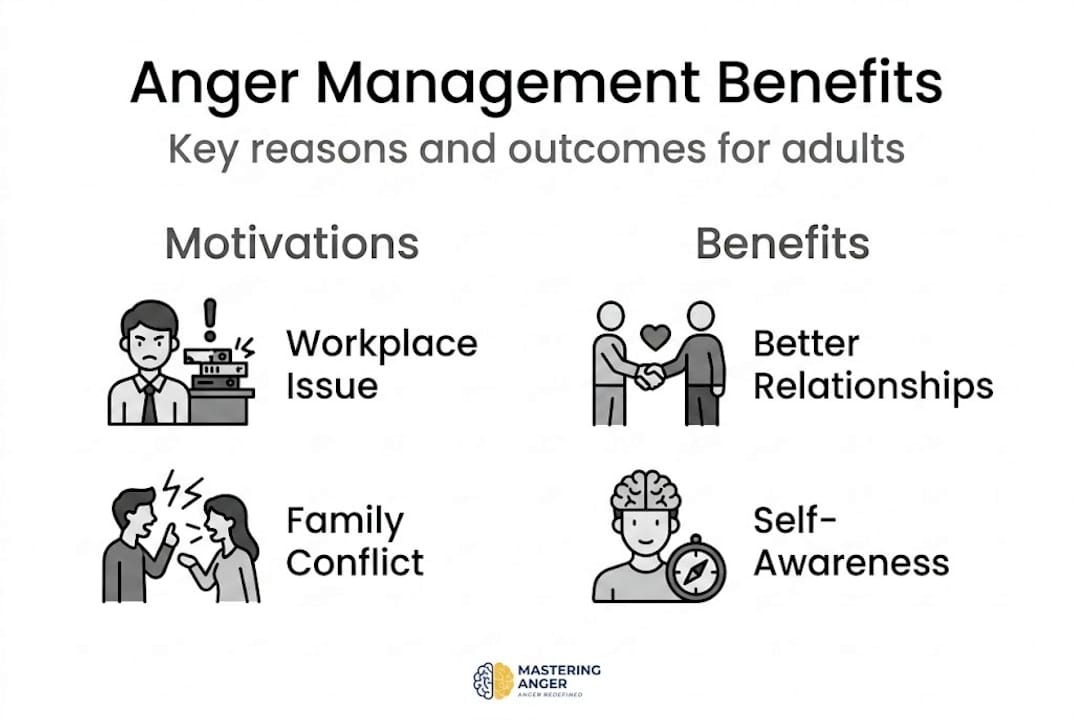
Think of anger like a dashboard warning light. It is telling you something real: a boundary has been crossed, a value has been threatened, or a need is going unmet. The problem is never the anger itself. The problem is what you do with that signal when it flashes. Programs teach you to read the light accurately and respond with purpose rather than panic.
Here are some of the most meaningful benefits participants consistently describe:
- Reduced regret and guilt after difficult conversations or conflicts
- Clearer communication that expresses needs without blame or attack
- Improved conflict resolution skills that reduce the frequency of arguments
- Stronger trust and safety in family, romantic, and workplace relationships
- Lower stress levels because chronic irritability decreases when you have tools to manage it
- More confidence in handling difficult people and situations calmly
Programs improve relationships through emotional regulation, clear communication, and conflict resolution. They reduce fear and resentment while actively building trust and safety in close relationships.
The relationship benefits extend outward in ways that are sometimes unexpected. When you stop relying on raised voices or withdrawal to manage conflict, the people around you respond differently. Partners feel safer being honest. Children become more open. Colleagues become more collaborative. The change in you creates a change in the system you live and work within.
You can explore common questions and real-world examples in the anger management FAQs section, which addresses everything from what to expect in your first session to how certificates are issued and accepted.
For many adults, the most unexpected benefit is a sense of agency. Anger can feel like something that happens to you, like a storm rolling in without warning. After working through a structured program, most participants describe it differently: as a signal they can read, understand, and respond to deliberately. That shift from reactive to intentional is one of the most meaningful changes a person can make.
Our view: Rethinking anger management in real life
Here at MasteringAnger.com, we have worked with thousands of adults across the country since 2009, and the pattern we see again and again is this: the people who benefit most are not necessarily the ones who arrive the most motivated. They are the ones who stop treating this as punishment and start treating it as skill-building.
Anger is not a flaw. It is a signal for your boundaries and values. The real work of anger management is learning to channel that signal productively rather than letting it control you. Voluntary participants often achieve higher engagement and personal growth compared to mandated participants, but that gap closes fast once someone decides to show up fully, regardless of how they got there.
We have seen this with military veterans processing years of compressed stress, with parents desperate not to repeat cycles from their own childhoods, and with professionals who realized their career trajectory depended on changing how they handled pressure. Every one of them arrived with a different story. Every one of them left with something they could use. Learning these skills early, before a crisis forces the issue, is not weakness. It is one of the most practical things an adult can do. You can read more about evidence-based program outcomes and see how real compliance-grade programs are structured to support lasting change.
Find the right anger management program for your needs
If you are ready to take a meaningful step forward, certified and accessible programs exist for both court-mandated requirements and personal growth goals. You do not have to figure out which program fits your situation on your own.
At MasteringAnger.com, we offer online courses ranging from 4 to 52 hours, all built on evidence-based clinical curriculum developed by Dr. Carlos Todd, a licensed mental health counselor with decades of experience. Certificates are accepted by courts, employers, probation officers, and licensing boards across the country. If you are in a specific state, you can explore Arizona anger management classes as one example of our state-specific options. Or you can browse all available online anger management classes and find the right fit for your timeline, your goals, and your situation.
Frequently asked questions
Is anger management only for people with legal issues?
No, many adults choose anger management to improve relationships and personal well-being, not just to satisfy court orders. Voluntary participants often seek help because they recognize anger’s impact on their closest relationships and daily quality of life.
What are the main methods used in anger management programs?
Cognitive Behavioral Therapy (CBT) and Acceptance and Commitment Therapy (ACT) are the most widely used approaches. These core methodologies teach emotional regulation, trigger identification, and practical communication skills.
Are court-ordered anger management classes effective?
Court-ordered classes can reduce repeat offenses, though research shows re-assault effects for some traditional models are modest. Voluntary participation and program quality both play a significant role in how much a participant gains.
What personal benefits can anger management bring?
Participants regularly report improved emotional regulation, healthier relationships, and less regret after conflicts. Programs build trust and safety in both personal and professional relationships over time.
Recommended
- Why schools can benefit from anger management | Masteringanger.com®
- Anger Management for ADHD Adults: A Practical Guide
- 7 Healthy Ways to Express Anger for Adults in Conflict
- Anger Management for Parents: Strategies to Stay Calm | Masteringanger.com®
Dr. Carlos Todd PhD LCMHC specializes in anger management, family conflict resolution, marital and premarital conflict resolution. His extensive knowledge in the field of anger management may enable you to use his tested methods to deal with your anger issues.

Responses