 English
 Spanish

What is a professional anger management program? A 2026 guide

TL;DR:
- Professional anger management programs are structured, evidence-based interventions facilitated by certified specialists.
- Studies show these programs significantly reduce anger outbursts and aggression with high completion rates.
- Tailored programs meet specific legal, workplace, or personal needs, ensuring effective and compliant outcomes.
Anger management programs carry an unfair reputation. Many people assume they exist as punishment for “troublemakers,” when in reality they are structured, evidence-based educational tools used every day by courts, employers, and individuals who simply want to respond to life’s pressures more effectively. Whether you’ve been court-ordered, referred by an employer, or are pursuing personal growth on your own terms, understanding what these programs actually involve can transform how you approach the process. This guide walks you through how professional programs are defined, what you experience inside them, how effective they really are, and how to match the right program to your specific circumstances.
Table of Contents
- Defining a professional anger management program
- What happens in a typical program?
- How effective are professional anger management programs?
- Tailoring programs for special populations and requirements
- The truth most guides miss about anger management programs
- Find the right program for you
- Frequently asked questions
Key Takeaways
| Point | Details |
|---|---|
| Structured and certified | Professional programs are evidence-based and delivered by licensed specialists, ensuring compliance and quality. |
| Flexible formats | Programs are offered online, in-person, and in group or individual formats to fit different needs. |
| Proven effectiveness | Research supports that anger management programs reduce outbursts and aggression, especially when CBT is used. |
| Customizable for mandates | Courses can be tailored for courts, workplaces, or special populations and provide proper documentation. |
Defining a professional anger management program
Now that we’ve challenged the most common misconception, let’s define exactly what makes an anger management program “professional.”
At its core, a professional anger management program is a structured psychoeducational intervention. That’s a clinical way of saying it combines education with skill-building in a deliberate, organized format. These programs are designed and facilitated by certified specialists who follow recognized standards. They aren’t casual conversations or vague “talk it out” sessions. They have a curriculum, a sequence, and a measurable outcome.
According to Forbes Health, professional programs in the US are structured psychoeducational interventions, often court-ordered, delivered online or in-person by certified specialists, with durations ranging from 1 to 52 hours to meet legal requirements. That range matters. It means there’s a program designed for your specific situation, whether you need a brief 4-hour course or a more intensive 52-hour commitment.
Professional programs serve three major goals:
- Reducing destructive anger by teaching you to recognize and interrupt harmful patterns before they escalate
- Improving coping skills so you have practical tools ready when stress, frustration, or conflict shows up
- Fulfilling legal or workplace mandates with verifiable documentation that courts, attorneys, and HR departments can independently confirm
Delivery formats vary to fit different schedules and preferences. You may complete a self-paced online course, join a live virtual group session, attend in-person classes, or work through individual sessions with a counselor. Each format uses the same evidence-based foundation, just adapted to different learning environments.
“A professional program is not a sign of weakness. It’s a structured path toward better emotional control, with documentation to prove you’ve walked it.”
Certification and documentation are what separate a professional program from a YouTube video or a self-help book. Upon completion, you receive a certificate of completion, a provider letter, and a completion report. These documents include provider credentials, course hours, and verification details, allowing courts and employers to confirm legitimacy. If you’re navigating legal program requirements, this paperwork is essential, not optional.

What happens in a typical program?
With an understanding of what these programs are, let’s look at what actually happens when you enroll.
Most professional anger management programs follow a logical, step-by-step structure designed to build self-awareness before introducing new skills. Here’s how a typical program unfolds:
- Anger education – You start by learning what anger actually is: a normal, biological emotion with physical, mental, and behavioral dimensions. Think of it like a dashboard warning light. It signals that something needs attention, not that you are broken.
- Trigger identification – You identify your personal anger triggers, the specific situations, words, or environments that tend to escalate your emotional response.
- Thought pattern exploration – Programs use cognitive-behavioral strategies to help you notice how your thinking influences your reaction. A distorted thought can turn a minor inconvenience into a major conflict.
- Skill building – This is where emotional regulation, communication strategies, and impulse control tools are introduced and practiced through exercises.
- Progress assessment – Quizzes and checkpoints measure your understanding and growth throughout the course.
- Certificate of completion – After meeting all requirements, you receive your official documentation.
You can compare course formats to find the delivery method that suits you best. Mastering Anger programs, for example, feature self-paced modules with quizzes, progress assessments, and certificates of completion in individual, group, and virtual formats.
Pro Tip: Save every piece of documentation your program provides, including your certificate, provider letter, and any assessment results. Courts and employers sometimes request additional verification beyond the certificate itself, and having the full file saves you time and stress.
If you’ve been ordered to choose court-accepted programs, confirm acceptance before you enroll, not after. That one step protects your compliance standing.
How effective are professional anger management programs?
Understanding the process, it’s natural to ask: do these programs really work?
The short answer is yes, and the data backs it up. A meta-analysis published in IRE Journals found that CBT-based programs achieve a 50 to 70 percent reduction in anger outbursts and a 76 percent success rate in reducing aggression. Effect sizes are significant: d=0.76 for anger reduction and d=0.82 for aggression, which are considered large effects in psychological research. Mandated programs also show higher completion rates, around 70 percent, compared to voluntary enrollment.
| Outcome Measure | Result |
|---|---|
| Reduction in anger outbursts | 50 to 70% |
| Aggression reduction via CBT | 76% success rate |
| Effect size: anger reduction | d = 0.76 (large) |
| Effect size: aggression | d = 0.82 (large) |
| Completion rate (mandated) | ~70% |
These numbers matter because they tell you that the structure of a professional program is doing real work, not just filling hours on a calendar.
Key benefits reported by program graduates include:
- Fewer emotional outbursts in daily life
- Stronger personal and professional relationships
- Better impulse control under stress
- Lower recidivism rates for those with legal involvement
- Increased self-awareness about triggers and patterns
Factors that influence your results include the intervention model used, the length of the program, your personal level of engagement, and how well the program matches your specific situation. You can explore program results and evidence in more detail, or learn how structured programs contribute to cutting recidivism for individuals with legal involvement.
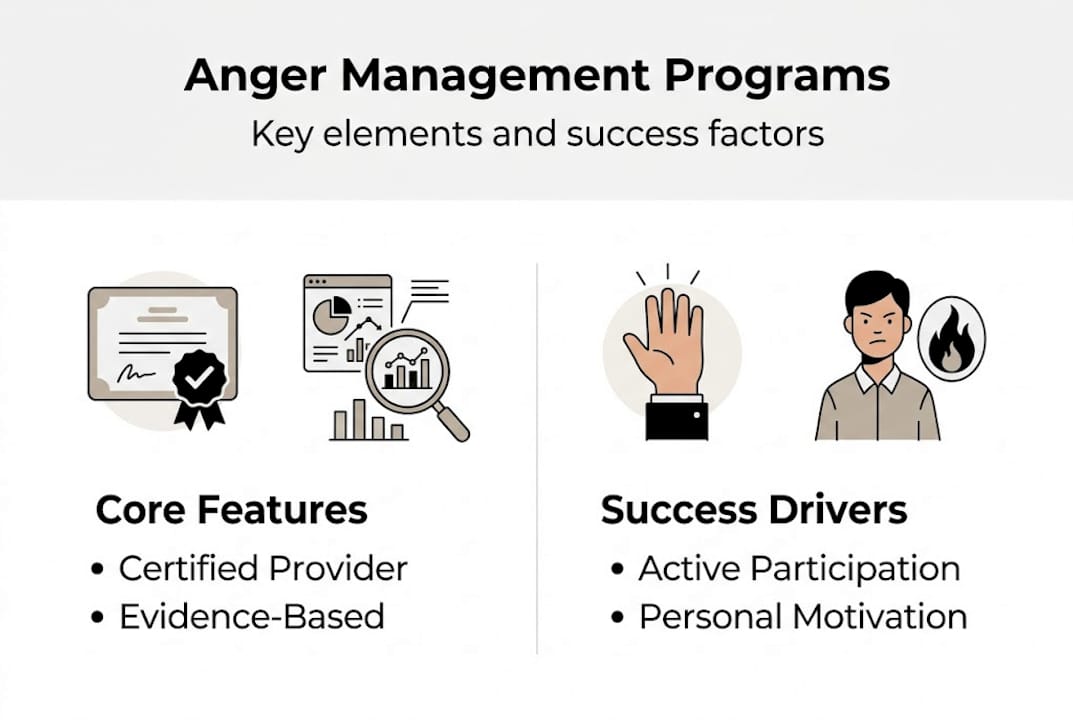
Motivation plays a role too. Even if you started this process because you had to, choosing to engage fully makes a measurable difference in what you take away.
Tailoring programs for special populations and requirements
Not every client is the same. Let’s see how programs match different needs and legal requirements.
A standard anger management program works well for many people. But some situations call for a more targeted approach. Research published in the Journal of Behavioral and Somatic Medicine found that tailored CBT for special populations, including post-MI patients and trauma survivors, improves outcomes beyond emotional regulation, with measurable effects on physical health markers like endothelial function. That’s a powerful reminder that anger is not just a mental experience. It affects the body too.
Additionally, research in Nature Scientific Reports confirms that anger links to maladaptive strategies like avoidance, rumination, and suppression, while adaptive strategies like acceptance and reappraisal reduce it. Effective programs are designed to target these specific patterns directly.
| Population | Program Adaptation |
|---|---|
| Court-mandated clients | Compliance verification, reporting to courts, specific hour requirements |
| Workplace/employer-referred | HR documentation, professional conduct focus |
| Trauma survivors | Trauma-informed pacing, safety-first approach |
| Post-MI or medical patients | Multimodal CBT, physical health integration |
| Self-enrolled individuals | Flexible scheduling, personal growth focus |
Pro Tip: Always confirm that your chosen program explicitly meets your mandate before you begin. A program that works beautifully for self-improvement may not satisfy a court order if it lacks specific documentation or hour requirements. Check the details on legal documentation tips and review guidelines on ensuring compliance so you’re protected from day one.
Matching the program to your real situation is not a formality. It’s the foundation of your results.
The truth most guides miss about anger management programs
Most mainstream guides focus on explaining what anger management programs contain and why anger is harmful. What they rarely address is the critical issue of fit.
Here’s something we’ve seen consistently: a program that perfectly satisfies a court mandate doesn’t automatically serve someone seeking workplace growth, and vice versa. The curriculum content may overlap, but the structure, length, documentation, and engagement style need to align with your specific circumstances. Choosing based on convenience alone often leads to repeating the process.
We also believe that lasting change doesn’t come from simply learning about anger. It comes from practicing specific adaptive strategies in your real, daily life, not just in a classroom. The real role of programs is to give you tools and then create enough structured repetition that those tools become instinctive.
Personalization matters at every level: the duration you choose, the delivery format, the population the program was built for, and how actively you engage over time. Programs that adapt to trauma recovery, health conditions, or unique legal standards consistently produce better results. The best program isn’t necessarily the most popular one. It’s the one built for someone in your exact situation.
Find the right program for you
Ready to take the next step? Here’s where to find the right certified program for your needs.
At MasteringAnger.com, every program is designed to meet court, employer, and personal development standards. Operated by Dr. Carlos Todd, PhD, LCMHC, since 2009, the platform offers certified courses from 4 to 52 hours, with documentation accepted by courts, probation offices, attorneys, and HR departments nationwide.
You can explore state-specific options, including Arizona anger classes and Washington anger programs, to confirm availability and acceptance in your jurisdiction. Not sure which course length fits your mandate? Review the full components of programs to understand exactly what each format includes before you commit. If you have a legal or workplace requirement, starting with an assessment is the smartest first step toward full compliance.
Frequently asked questions
What is required to complete a professional anger management program?
You must attend all sessions, actively participate, and pass assessments to receive a certified completion document. Programs like those at Mastering Anger include self-paced modules, progress checks, and certificates formatted for court or employer submission.
Are online anger management programs as effective as in-person?
Certified online programs can be equally effective, particularly when they use CBT methodologies and require structured assessments. Meta-analyses confirm large effect sizes for both anger reduction and aggression across compliant program formats.
Can a program certificate fulfill a court or employer mandate?
Yes, certificates from accredited programs meet legal and workplace requirements as long as the issuing provider meets the standards set by the court or agency. Always verify acceptance before enrolling.
How long do professional anger management programs take to complete?
Course lengths vary considerably. Some are as short as a single session, while others extend to 52 hours based on your court order or employer requirement. Programs range from 1 to 52 hours to accommodate diverse mandates.
What makes a program “professional” and legally recognized?
A program earns that designation through certified curriculum, an evidence-based approach, and documentation designed to comply with court, workplace, or state mandates. Verification details like provider credentials and company EIN allow independent confirmation of legitimacy.
Recommended
- Online anger management programs for court mandates 2026
- Anger Management For Professionals Under Constant Pressure | Masteringanger.com®
- Certified anger management exercises list for adults 2026
- Program Components | Masteringanger.com®
Dr. Carlos Todd PhD LCMHC specializes in anger management, family conflict resolution, marital and premarital conflict resolution. His extensive knowledge in the field of anger management may enable you to use his tested methods to deal with your anger issues.


Responses