 English
 Spanish

Why courts accept anger management: ensuring compliance

TL;DR:
- Courts prioritize evidence-based, credentialed anger management programs for true rehabilitation.
- Program verification includes licensed providers, standardized assessments, and comprehensive completion certificates.
- Online programs are widely accepted if they meet court standards and documentation requirements.
Most people assume that finishing any anger management course will satisfy a court order. That belief causes real problems. Courts reject programs every year because they lack proper credentials, missing documentation, or unverified provider licenses, forcing people back into hearings they thought were behind them. If you are navigating a court mandate right now, understanding exactly what makes a program court-accepted is not just helpful, it is essential. This guide walks you through the legal logic behind court mandates, the specific criteria programs must meet, the role of evidence-based methods, and how to choose the right format so you can move forward with confidence.
Table of Contents
- The legal and rehabilitative logic behind court-ordered anger management
- What makes an anger management program court-accepted?
- The role of evidence-based methods and psychological assessments
- Online vs. in-person programs: What courts allow and why
- A hard look: What courts, programs, and real-world data actually show
- Take the next step: Verified anger management classes that courts recognize
- Frequently asked questions
Key Takeaways
| Point | Details |
|---|---|
| Proof is required | Courts only accept programs with verified licenses, accreditation, and completion certificates. |
| Methods matter | Evidence-based approaches like CBT increase acceptance and effectiveness according to legal standards. |
| Online often accepted | Most courts allow accredited online anger management, but confirm your jurisdiction’s rules first. |
| Not all programs equal | Programs and outcomes vary; choose those with transparent documentation and proven results. |
The legal and rehabilitative logic behind court-ordered anger management
Courts do not order anger management as a form of punishment. That distinction matters more than most people realize. When a judge signs an order for anger management, the goal is rehabilitation, meaning the court wants to see you develop real skills that reduce the risk of future conflict. Think of it like a dashboard warning light in your car. The light is not the problem; it signals something underneath that needs attention. Anger management works the same way.
Court-mandated anger management programs are built around three core legal goals:
- Reducing recidivism: Courts want evidence that participants are less likely to repeat harmful behavior.
- Building coping skills: Judges look for programs that teach you to recognize your triggers and respond rather than react.
- Protecting public safety: Completion of a credible program signals to the court that a real intervention took place.
The skills courts expect you to gain are specific. You should be able to identify personal anger triggers, practice self-control techniques under stress, communicate assertively without aggression, and use de-escalation strategies in conflict situations.
“Courts mandate programs for rehabilitation over punishment, focusing on triggers, coping, and CBT. Acceptance hinges on accreditation and verification to track compliance.” Court-accepted anger management programs
Cognitive Behavioral Therapy, or CBT, is the psychological method most courts rely on when evaluating program quality. CBT works by helping you identify the thought patterns that fuel angry reactions and replace them with more constructive responses. It is not abstract theory. It is a structured, teachable skill set with decades of research behind it. Courts trust CBT-based curricula because the outcomes are measurable, which makes compliance tracking far more reliable.
Now that you know what is at stake, let us clarify exactly what courts require from a qualifying program.
What makes an anger management program court-accepted?
Having explored why standards matter, let us detail exactly what courts are looking for in an anger management program. Not every program that calls itself “court-approved” actually meets the bar. Courts check for a specific set of features before accepting any certificate.
At minimum, a court-approved program must include:
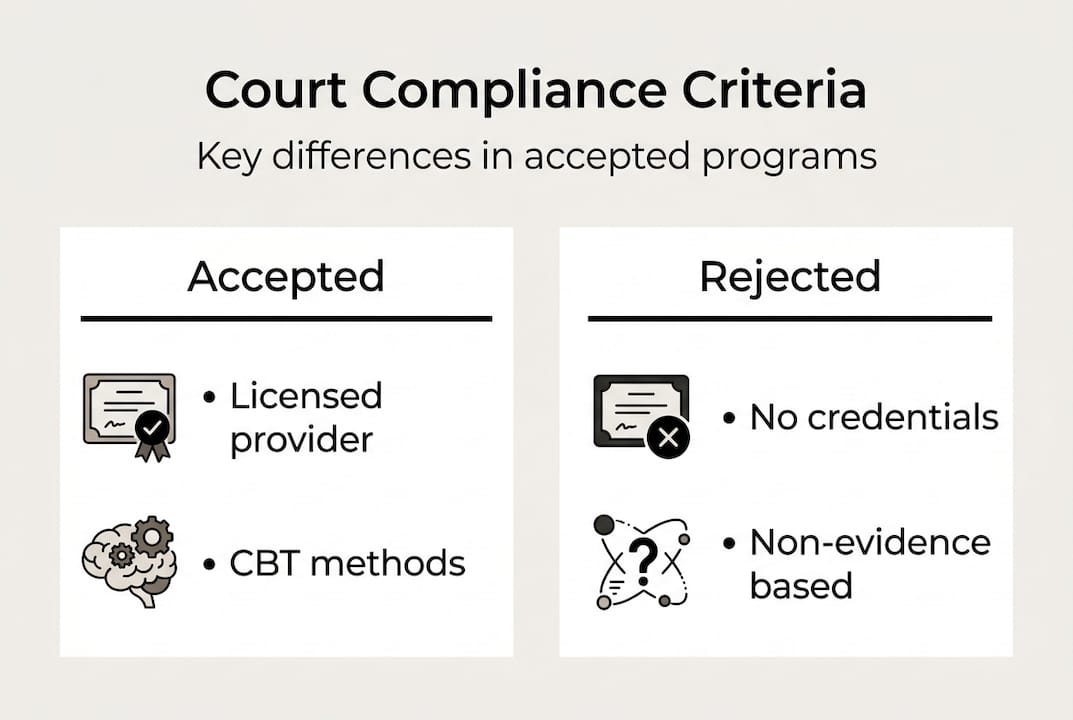
- Provider credentials: The program must be run by a licensed mental health professional, such as a licensed counselor or psychologist.
- Accreditation: The organization must be verifiable, with a company EIN and contact information courts can independently confirm.
- Curriculum hours: The number of completed hours must match what the court specified in your order.
- Completion certificate: The certificate must include your name, case-relevant details, provider license number, course hours, and the date of completion.
- Psychological assessment: Many courts require that course length be determined by a standardized assessment, not self-selection.
When courts receive your certificate, they look for court-approved course criteria like provider license numbers, the EIN of the issuing organization, and verifiable contact details. A certificate that lacks any of these elements is likely to be questioned or rejected.
| Feature | Court-accepted program | Program likely rejected |
|---|---|---|
| Provider credentials | Licensed mental health professional | Unlicensed coach or self-help author |
| Accreditation | Verifiable EIN and credentials | No verifiable organization details |
| Assessment included | Standardized intake assessment | No assessment, self-selected hours |
| Completion certificate | Includes hours, license, case info | Generic certificate, no credentials |
| Curriculum basis | Evidence-based (CBT or equivalent) | Anecdotal or unverified methods |
A course comparison for compliance can help you spot the difference before you invest time and money in a program that will not hold up.
Pro Tip: Before enrolling in any program, email or call the provider and ask for a sample certificate and their provider license number. If they cannot produce both quickly, keep looking.
The role of evidence-based methods and psychological assessments
Ensuring paperwork matches court requirements is crucial, but what is inside those programs matters just as much. Courts are increasingly aware that not all curricula are equal. A program that teaches breathing exercises alone is not the same as one grounded in proven conflict resolution strategies backed by clinical research.
Programs must use evidence-based curricula like CBT to ensure both compliance and real effectiveness. Here is why that matters to you: courts are not just checking that you showed up. They want to see that the program had the capacity to produce measurable change.
Meta-analyses show moderate effectiveness of anger management treatments, with effect sizes ranging from 0.7 to 0.9. Notably, arousal-decreasing techniques like relaxation training outperform arousal-increasing methods. That research shapes what courts trust.
| Method | Evidence level | Primary benefit |
|---|---|---|
| Cognitive Behavioral Therapy (CBT) | High | Restructures thought patterns driving anger |
| Relaxation and mindfulness techniques | High | Reduces physiological arousal quickly |
| Psychoeducation only | Moderate | Builds awareness but limited skill transfer |
| Traditional talk therapy models | Low to moderate | Varies widely by facilitator skill |
A psychological assessment is the starting point for a quality program. Here is what that process typically looks like:
- Intake screening: You complete a standardized tool, such as the Conover Assessment, measuring anger intensity and impulse-control risk.
- Course length recommendation: Results determine whether you need 4, 8, 16, or more hours, rather than guessing.
- Skills-building sessions: You work through CBT-based modules covering triggers, thought patterns, communication, and coping strategies.
- Progress documentation: Your responses and completion data are recorded and included in the final report sent to the court.
This structured process gives courts confidence that the program was individualized and clinically sound, not just a box to check.
Online vs. in-person programs: What courts allow and why
With a clear grasp of what constitutes an approved program, you now need to choose a suitable format. The good news is that online options have become widely accepted, but with important exceptions you need to know before enrolling.
Over 60% of U.S. courts accept accredited online programs if they meet documentation and credential standards. However, some jurisdictions require in-person attendance for high-risk cases, particularly those involving domestic violence or repeat offenses.

Here is a clear breakdown of both formats:
Online programs:
- Accessible from anywhere in the U.S., which is ideal if you travel or have a demanding schedule.
- Completion is tracked digitally, and certificates are issued quickly.
- More affordable in most cases.
- Accepted for the majority of non-violent mandates.
- Requires confirmation from your court or attorney before enrolling.
In-person programs:
- Required in some jurisdictions for domestic violence cases or high-risk classifications.
- Allows for direct facilitator observation, which some courts value.
- Less flexible in scheduling and often more expensive.
- May be the only option accepted in certain states or counties.
Learning about online program acceptance in your jurisdiction is a step you cannot skip. The safest approach is to complete court-ordered classes online only after getting written or documented confirmation from your attorney or the court clerk that online completion is permitted for your specific case.
Pro Tip: Ask your attorney or probation officer to confirm in writing that an online program is acceptable for your case type. Save that confirmation. If questions arise later, you will have documentation to support your compliance.
A hard look: What courts, programs, and real-world data actually show
So what does all this mean for those who want both court compliance and lasting skills? The honest answer is that compliance and genuine growth are not always the same thing, and that gap is worth understanding.
Many courts still rely on program models that have not kept pace with current psychological research. While practitioner sites tout 50-70% success rates, academic meta-analyses show more modest overall effects, and some batterer intervention programs show small or no reduction in recidivism. That does not mean programs are worthless. It means the quality of the curriculum and the skills you actually practice matter far more than the hours logged.
The impact on recidivism is real when programs are grounded in updated, evidence-based methods and when participants engage genuinely rather than passively. Checking a box gets you through a court date. Practicing the skills gets you through the next conflict without one.
Our honest recommendation: look for programs that publish their curriculum basis, use standardized assessments, and are run by licensed clinicians. Transparency is a signal of quality. If a provider cannot tell you exactly what method their curriculum is based on, that is worth noticing.
Take the next step: Verified anger management classes that courts recognize
Ready for compliance and personal growth? Here is how you can get started with a verified program.
At MasteringAnger.com, every program is built on Dr. Carlos Todd’s clinically developed curriculum, grounded in CBT and evidence-based conflict resolution. Courses range from 4 to 52 hours, and all certificates include provider credentials, EIN, license numbers, and case-specific documentation that courts, attorneys, and employers can independently verify.
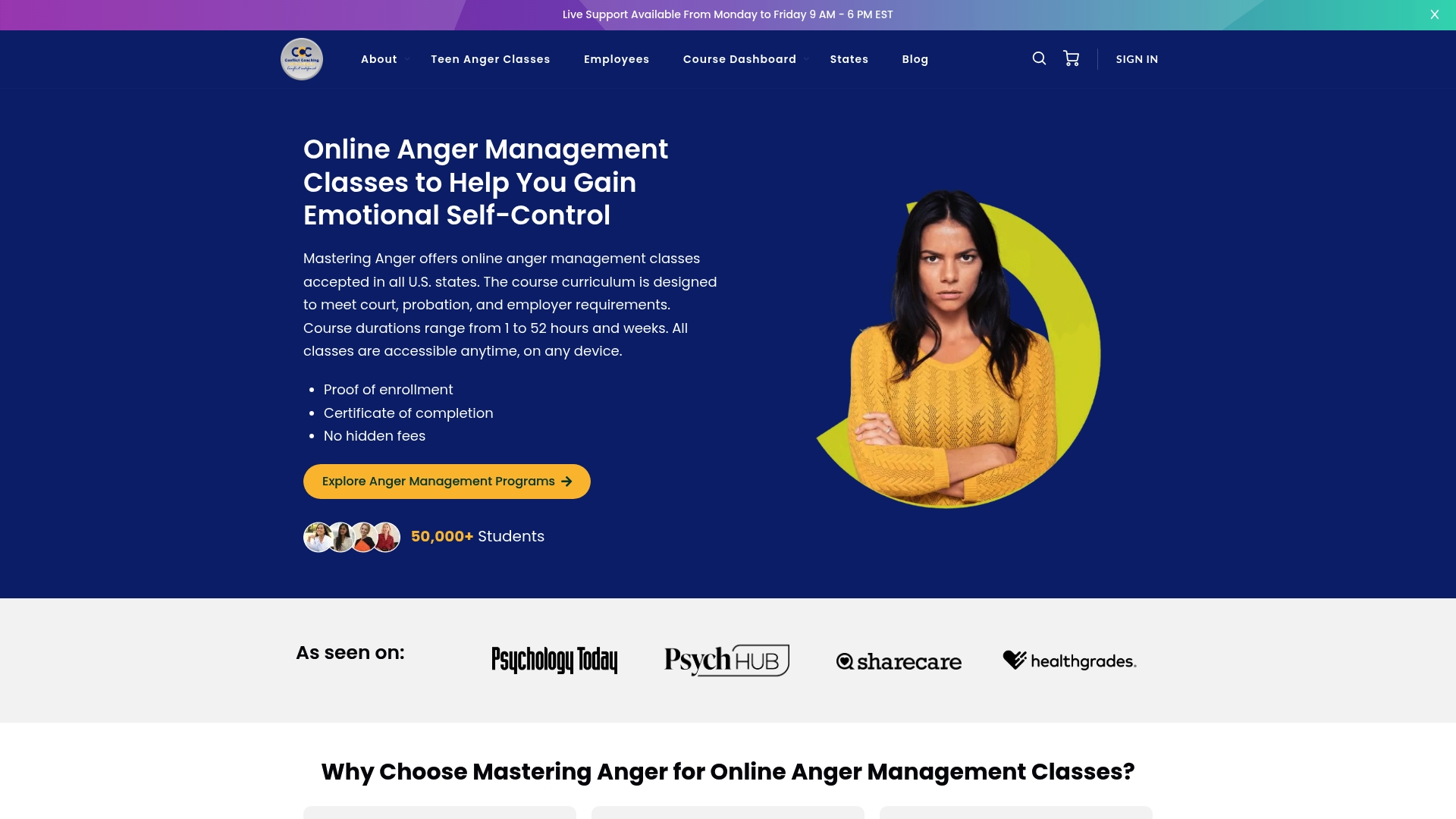
Whether you need Arizona anger management classes, Washington anger management classes, or access to a nationally recognized court-approved anger management program, MasteringAnger.com has served thousands of mandated clients across the U.S. since 2009. You can start your assessment today and receive your certificate without delays or guesswork.
Frequently asked questions
What documentation do courts need from anger management programs?
Courts need proof of accreditation, the provider’s license or credentials, total program hours, and a completion certificate that includes your name, case-relevant information, and the provider’s contact details. Missing any of these elements can result in the certificate being rejected.
Can I complete anger management online for a court order?
Over 60% of U.S. courts accept accredited online programs when they meet credential and documentation standards, but you should always confirm with your specific court or attorney before enrolling to avoid complications.
How many hours of anger management does the court require?
Requirements vary based on offense severity. Programs range from 4 to 52 hours, and the correct length is typically determined by a standardized psychological assessment or specified directly in your court order.
Do all court-accepted programs work equally well?
No. Programs built on evidence like CBT show stronger outcomes, while some older models have limited impact on repeat offenses. Choosing a program with a transparent, research-backed curriculum gives you both compliance and a better chance at lasting change.
Recommended
- Court Mandated Anger Management: Fulfilling Legal Requirements
- Online anger management programs for court mandates 2026
- Court-approved anger education: Choose the right program
- Choose anger management courses that meet court mandates
Dr. Carlos Todd PhD LCMHC specializes in anger management, family conflict resolution, marital and premarital conflict resolution. His extensive knowledge in the field of anger management may enable you to use his tested methods to deal with your anger issues.