
 English
 Spanish

Why attorneys request anger management: legal insight

TL;DR:
- Proactive enrollment in anger management shows accountability and can improve legal case outcomes.
- Different case types (criminal, family, employment) benefit from anger management by signaling emotional control and responsibility.
- Choosing a court-accepted, evidence-based program with proper documentation is essential for legal compliance and success.
Most people assume anger management is something a judge orders as a form of punishment. That assumption misses a much bigger picture. Attorneys request anger management primarily to demonstrate client accountability and proactive change to courts, improving case outcomes in criminal, family, and employment matters. When you enroll before anyone tells you to, you send a powerful signal: you recognize the problem and you are already doing something about it. This guide breaks down the real reasons attorneys recommend these programs, how they affect different types of cases, and what you need to know to make the most informed decision possible.
Table of Contents
- Why attorneys recommend anger management before court mandates
- How anger management influences criminal, family, and employment law cases
- What to expect from attorney-recommended anger management programs
- How to choose a court-accepted anger management program
- The overlooked advantage: Why going beyond the minimum matters
- Find court-accepted anger management programs near you
- Frequently asked questions
Key Takeaways
| Point | Details |
|---|---|
| Attorney strategy | Lawyers recommend anger management to show accountability and improve case outcomes. |
| Impact on cases | Proactive participation can positively influence criminal, family, and work law situations. |
| Program choice matters | Selecting a court-approved program and getting proper documentation is essential. |
| Early action helps | Starting anger management before a mandate shows sincerity and can reduce recidivism. |
Why attorneys recommend anger management before court mandates
Think of proactive enrollment in anger management like arriving early to a job interview. You haven’t been told you have to be there at a specific time, but showing up early tells the interviewer something important about your character. Judges and prosecutors notice the same thing.
Attorneys who work in criminal defense, family law, and employment cases understand that demonstrating initiative is one of the most persuasive moves a client can make. When you walk into a courtroom already enrolled in or having completed an anger management program, you reframe the narrative entirely. You are no longer just someone accused of something. You are someone who recognized a problem and took action.
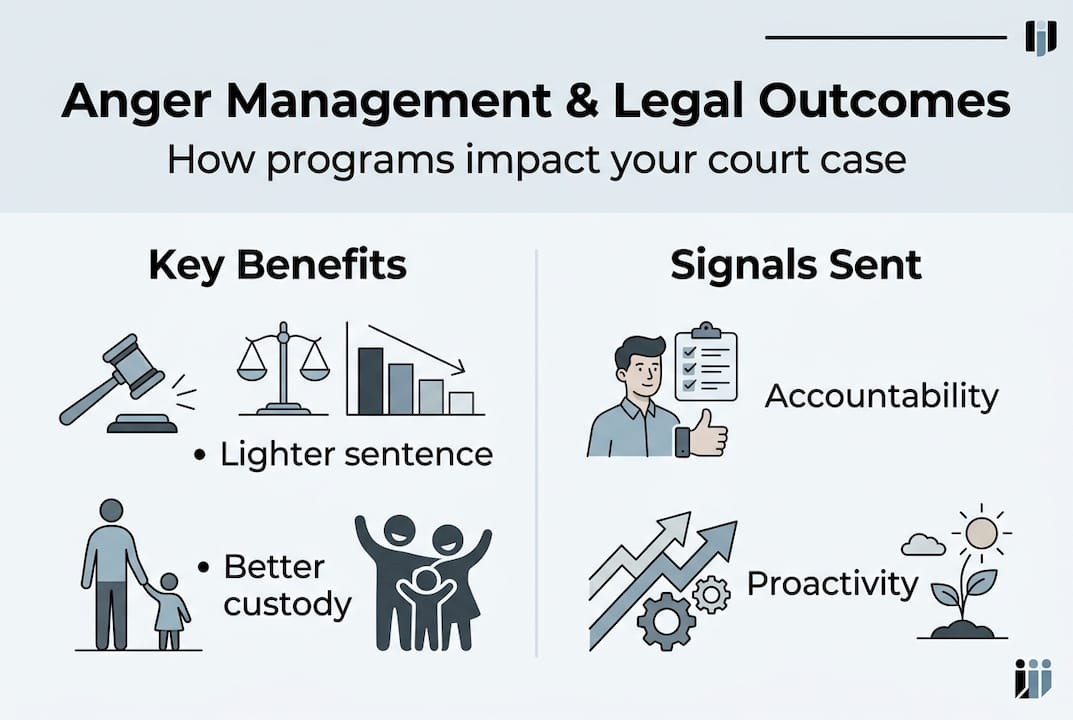
Proactive enrollment benefits your case in concrete ways. In criminal settings, attorneys recommend pre-court enrollment to support plea bargains, reduced charges, or lighter sentences, and to mitigate overall sentencing exposure. A prosecutor who sees genuine accountability is more likely to offer a favorable deal.
Here is what proactive enrollment typically accomplishes from a legal strategy standpoint:
- It signals remorse and self-awareness to the court
- It gives your attorney a tangible tool to use in negotiations
- It may qualify you for diversion programs or deferred judgments
- It reduces the risk of maximum sentencing
- It builds credibility before testimony or hearings begin
For clients navigating court-mandated requirements, enrolling early also means you are ahead of any timeline the court might set. That breathing room matters.
“The most effective legal strategy is not just building a defense. It’s demonstrating to the court that the client is invested in being a better person going forward.”
Pro Tip: Ask your attorney to confirm that your chosen program issues verifiable documentation. Courts look for provider credentials, company identification numbers, and course hours on any certificate. Getting documentation early is essential for court acceptance and gives your legal team something concrete to present.
How anger management influences criminal, family, and employment law cases
Once attorneys have determined the value of early enrollment, the next consideration is how specific case types are affected. Anger management does not play the same role in every courtroom, and understanding the differences helps you see why your attorney may be pointing you in this direction.
In family court, the stakes often involve your relationship with your children. Anger management influences custody and visitation decisions positively by evidencing emotional control and commitment to improvement. A parent who can show completed coursework and a certificate from a verified provider demonstrates to the judge that the children’s environment will be safer and more emotionally stable.

In criminal court, anger management can shift the entire outcome of a case. Prosecutors weighing whether to pursue maximum charges are more inclined toward leniency when they see a defendant already working on the root cause of their behavior. Defense attorneys often use completion certificates as part of plea negotiations, and judges factor them into sentencing decisions.
In employment cases, whether you are dealing with a workplace investigation, termination dispute, or HR requirement, completing an anger management program shows your employer and any arbitrator that you are committed to professional conduct. That commitment can make the difference between a final warning and job loss, or between a favorable and unfavorable settlement.
Here is a comparison of how anger management applies across these three legal contexts:
| Case type | Primary benefit | What it signals to decision-makers |
|---|---|---|
| Criminal | Reduced charges or lighter sentence | Remorse and intent to change |
| Family | Improved custody or visitation outcomes | Emotional stability and parenting fitness |
| Employment | Mitigated discipline or termination risk | Professional accountability |
Your attorney will evaluate court acceptance criteria for your specific situation to determine the best approach. The right program length, format, and provider all factor into that decision. A legal strategy for emotional cases is rarely one-size-fits-all, which is why understanding the context of your case matters so much.
What to expect from attorney-recommended anger management programs
Having seen the importance of anger management in different legal contexts, it is also crucial to know what these programs actually involve and what to expect when you enroll.
Most court-accepted programs are built around evidence-based therapies. The gold standard is CBT, or Cognitive Behavioral Therapy, which shows a 76% success rate in reducing aggression. Programs also incorporate ACT (Acceptance and Commitment Therapy) and Emotional Regulation strategies. Together, these approaches help you understand what triggers your anger, how to interrupt the cycle before it escalates, and how to communicate more effectively under pressure.
You can expect your program to include:
- Trigger identification: Learning to recognize the situations, thoughts, and feelings that ignite your anger response
- Coping skill development: Practical tools like breathing techniques, cognitive reframing, and timeout strategies
- Communication training: How to express frustration without hostility or aggression
- Behavioral planning: Creating a personal action plan for high-risk situations
Program length is not arbitrary. It is determined by clinical assessment and by what the court or attorney recommends. Most programs range from 4 to 52 hours. A structured assessment helps identify your anger intensity and impulse-control risks, and then matches you to the appropriate course length.
Here is a general breakdown of how program length aligns with legal need:
| Program length | Typical use case |
|---|---|
| 4 to 8 hours | Minor workplace or first-time incidents |
| 12 to 16 hours | Moderate conflicts, misdemeanor-level cases |
| 24 to 36 hours | Repeat offenses or family court requirements |
| 52 hours | Serious criminal cases or high-risk assessments |
Completing a structured program is also associated with measurable improvement in recidivism outcomes, meaning people who genuinely engage with the material are significantly less likely to reoffend. For online program options that fit around your schedule, several flexible formats now exist that still meet court requirements.
Pro Tip: Do not guess at the program length you need. Completing a clinical assessment first ensures you enroll in the right course and prevents you from having to repeat hours if a court finds your initial choice insufficient.
How to choose a court-accepted anger management program
Understanding what the programs offer makes it easier to identify the right one. Here is how to make sure you are fully covered.
Not every anger management program is equal in the eyes of the court. Programs accepted by courts must meet certain evidence-based criteria, and both program length and delivery format (in-person or online) matter for compliance. Choosing the wrong program can mean starting over, and that wastes both time and money.
Follow these steps to choose wisely:
- Confirm court acceptance first. Ask your attorney or probation officer which providers or program types are acceptable. Some courts specify online versus in-person requirements.
- Verify the provider’s credentials. Look for licensed clinicians, company identification numbers, and a track record of acceptance by courts and legal professionals.
- Complete a clinical assessment. This ensures the program length matches your actual situation and gives you documentation that justifies your enrollment decision.
- Understand the documentation you will receive. A valid certificate should include provider credentials, course hours, assessment basis, and verifiable contact information for the issuing organization.
- Communicate completion to your attorney promptly. Do not wait until a hearing to share your certificate. Give your legal team time to incorporate it into your strategy.
For details on anger management paperwork and exactly what courts look for in compliance documents, reviewing specific legal documentation requirements ahead of time will save you significant stress. Also, make sure you understand the rules around matching court mandates before you commit to any program.
Pro Tip: Do not leave program selection to the last minute. Courses enrolled in just before a hearing may not carry the same weight as those completed weeks or months in advance. Courts notice timing.
The overlooked advantage: Why going beyond the minimum matters
Here is an honest perspective that most legal guides will not say directly: meeting the minimum is not always enough.
Attorneys sometimes tell clients to complete a basic course just to satisfy the requirement. That is understandable from a purely procedural standpoint. But judges and prosecutors are experienced observers of human behavior. They can tell the difference between someone who attended a few hours to check a box and someone who engaged genuinely with the material.
Proactive enrollment before mandates signals sincerity to judges and prosecutors, which is especially important for diversion programs like deferred judgments. People who complete these programs with real engagement show just an 8% recidivism rate post-completion. That number matters because it tells the court this person is statistically unlikely to be back.
We have seen individuals change their entire trajectories, not just legally but personally, by treating the program as an opportunity rather than a sentence. They stopped repeating harmful patterns. Their relationships improved. Their employment became stable. The legal benefit opened the door, but genuine engagement walked them through it.
If you are looking at programs beyond legal compliance, you are already thinking the right way. The minimum gets you through the hearing. Real effort gets you a different life.
Find court-accepted anger management programs near you
If you are ready to take this step, MasteringAnger.com makes it straightforward. We offer online, court-accepted anger management programs built on clinical evidence and accepted by courts, probation officers, attorneys, and employers across the United States.
Whether you need Arizona anger management resources, Virginia anger programs, or support in any other state, our platform connects you to the right program length and format for your situation. Start with a program evaluation to match your needs precisely. You will receive verifiable documentation upon completion, giving your attorney exactly what is needed to present your case in the strongest possible light.
Frequently asked questions
Do I have to wait for a court order before starting anger management?
No. Starting early is advised by many attorneys and is typically viewed favorably by courts as a sign of genuine accountability and initiative.
Will my case outcome definitely improve if I do anger management?
No outcome is guaranteed, but research shows that sincere proactive engagement frequently leads to lighter sentences, better plea deals, or more favorable decisions in family and employment matters.
What type of anger management program do courts prefer?
Most courts favor programs using evidence-based therapies like CBT with a 76% aggression-reduction rate, verified providers, and official documentation of completion.
How long does an attorney-recommended anger management program take?
Programs range from 4 to 52 hours depending on your clinical assessment results and the specific requirements of your legal situation.
Recommended
- Why courts accept anger management: ensuring compliance
- Court Mandated Anger Management: Fulfilling Legal Requirements
- How to get valid anger management legal documentation
- Role of Anger Management Classes for Legal Compliance
Dr. Carlos Todd PhD LCMHC specializes in anger management, family conflict resolution, marital and premarital conflict resolution. His extensive knowledge in the field of anger management may enable you to use his tested methods to deal with your anger issues.



Responses