 English
 Spanish
Psychoeducation in anger management: Your guide to compliance and real change

TL;DR:
- Psychoeducation provides structured, evidence-based skills for lasting anger control and emotional regulation.
- Legitimate programs include accreditation, assessments, and thorough documentation to satisfy legal requirements.
- Engaging deeply with these skills offers long-term benefits beyond mere compliance in court or work settings.
Anger management is not just about counting to ten or taking a deep breath. If you’ve been ordered by a court, referred by a probation officer, or required by your employer to complete an anger management program, you already know that the stakes are much higher than simply “calming down.” The real question is whether the program you choose will satisfy legal requirements and create lasting psychological change. Most people don’t realize there’s a significant difference between a generic class and a structured psychoeducational program, and that difference can determine whether your certificate holds up in court or gets dismissed entirely.
Table of Contents
- What is psychoeducation in anger management?
- How psychoeducation works: From triggers to lasting change
- Court, probation, and workplace: What counts as legitimate psychoeducation?
- Key skills taught in psychoeducational anger management
- A fresh perspective: Why court-approved psychoeducation matters more than you think
- Get started with a program that works—for you and the court
- Frequently asked questions
Key Takeaways
| Point | Details |
|---|---|
| Evidence-based programs work | Court-accepted psychoeducation programs show stronger results than generic classes for controlling anger. |
| Certification and documentation matter | Only accredited programs with proper records are accepted for legal or workplace compliance. |
| Skills go beyond ‘calming down’ | You learn practical methods for identifying triggers, regulating emotions, and lasting change. |
| Check program credentials | Always verify with the court or workplace and choose NACATP/CAMS-accredited courses. |
What is psychoeducation in anger management?
Psychoeducation is a structured, evidence-based method of teaching people how their emotions work at a psychological level. It is not just a list of tips. Think of it like learning how your car’s engine operates rather than just being told to press the brakes when you see red. When you understand why anger escalates, what happens in your brain during a trigger, and how your thought patterns fuel or defuse that reaction, you gain real control instead of temporary relief.
In the context of anger management, psychoeducation covers several essential areas:
- Trigger identification: Learning what situations, words, or thoughts spark your anger response
- Neurological awareness: Understanding what happens in the brain during anger (the amygdala response, the stress hormone flood, the narrowing of judgment)
- Cognitive restructuring: Recognizing and replacing distorted thoughts that make anger worse
- Emotion regulation: Developing practical tools to manage how you feel before, during, and after an angry episode
- Behavioral consequences: Mapping how anger-driven actions affect your relationships, career, and legal standing
This is very different from a generic class that hands you a breathing exercise sheet and calls it done. Courts, probation systems, and employers have grown more sophisticated about this distinction. They increasingly look for programs that include formal psychoeducational content because the research backing it is strong.
“Evidence-based psychoeducation is not a luxury add-on. For mandated clients, it is the foundation that makes a program both clinically credible and legally defensible.”
Studies confirm that CBT-based psychoeducation produces an effect size of 2.01 for anger control and 1.06 for cognitive flexibility, even in high-risk populations. These are not small improvements. They reflect meaningful, measurable change. Meta-analyses also report moderate to strong effects between 0.6 and 1.2 for CBT anger management overall.
When you look for courses that meet court mandates, the presence of a structured psychoeducational framework is one of the clearest markers of a legitimate, effective program. Without it, you may complete hours of content that teaches you very little and documents even less.
With the basics in mind, let’s break down how psychoeducation performs compared to standard approaches.
How psychoeducation works: From triggers to lasting change
Imagine anger as a smoke alarm. A generic class might teach you to fan away the smoke. Psychoeducation teaches you to find the fire, understand why it started, and prevent it from happening again. That is the fundamental difference in approach.
A CBT-based psychoeducational program walks you through a clear, repeatable process:
- Recognize your trigger: You identify the specific event, person, or thought that activates your anger
- Pause and observe: Instead of reacting immediately, you create a mental gap between the trigger and your response
- Analyze the thought: You examine what you told yourself in that moment (“They disrespected me,” “This is unfair”) and test whether that thought is accurate or distorted
- Reframe the interpretation: You replace the distorted thought with a more balanced, realistic one that reduces the emotional intensity
- Choose a regulated response: You select a behavior that matches the situation rather than the emotion
This step-by-step process is called cognitive reappraisal, and it is one of the most well-researched strategies in emotional health science. Research on adaptive emotion regulation confirms that anger is closely linked to maladaptive regulation strategies like rumination and suppression. Psychoeducation on adaptive strategies, including acceptance and reappraisal, directly addresses this pattern.
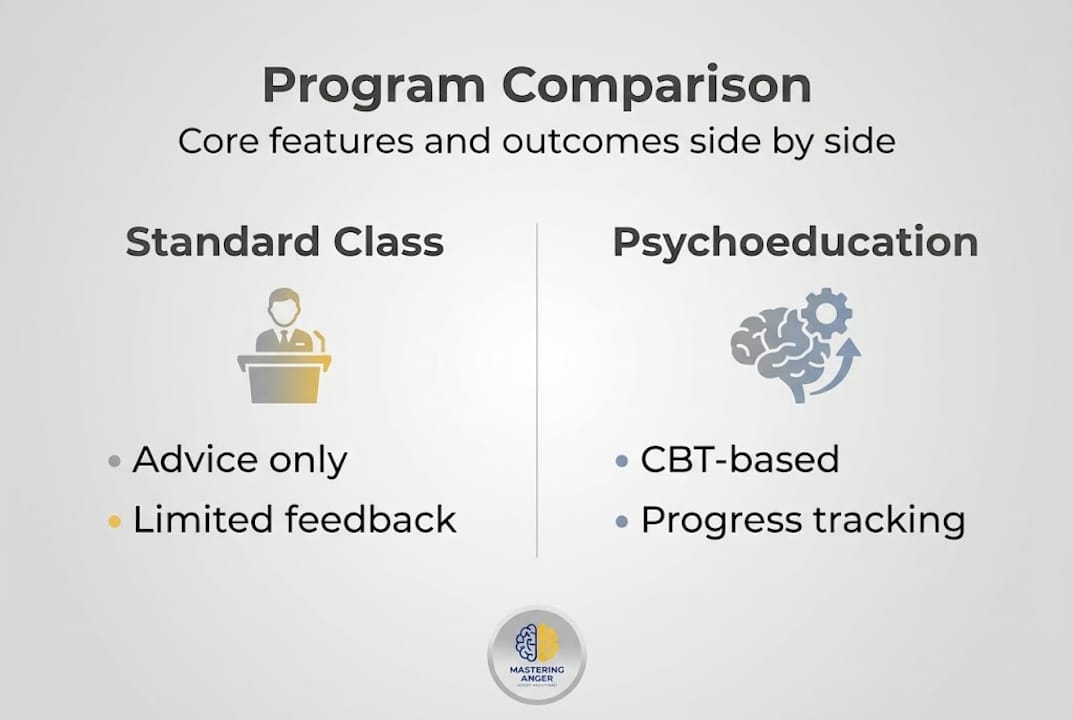
Here is a side-by-side look at how these two approaches compare:
| Feature | Generic anger management class | Psychoeducation-based program |
|---|---|---|
| Teaching method | Tips and worksheets | Structured, evidence-based modules |
| Trigger analysis | Minimal | In-depth and personalized |
| Cognitive tools | Rarely included | Core component (CBT framework) |
| Research backing | Limited | Strong (effect sizes 0.6 to 2.01) |
| Court credibility | Often insufficient | High when accredited |
| Documentation depth | Basic certificate | Assessment reports, progress records |
| Long-term skill building | Low | High |
The numbers matter here. CBT psychoeducation produces an effect size of 2.01 for anger control, which is considered a very large improvement by research standards. A score like that doesn’t happen by accident. It reflects a teaching model that actually changes how people think and respond.
Pro Tip: Always check that your program includes a formal psychoeducational module before enrolling. Ask the provider directly: “Does your curriculum include cognitive restructuring and emotion regulation training?” If they can’t answer clearly, that’s a red flag.
You can also review court acceptance explained to understand what legal systems look for in a program before you commit to one. And for a detailed breakdown of formats, the course format comparison page walks you through your options clearly.
Understanding the process leads naturally to your next concern: whether a program will actually “count” for legal compliance.
Court, probation, and workplace: What counts as legitimate psychoeducation?
Here’s a reality that surprises many people: completing any anger management class does not automatically satisfy a court or probation order. The program must meet specific credibility standards. Think of it the way you’d think about a diploma. A certificate from an unaccredited source raises questions. One from a recognized, accredited institution carries weight.
For court-mandated and probation situations, two accreditation bodies are most commonly recognized:
- NACATP (National Anger and Conflict Treatment Association of Professionals): Sets training and program standards for anger management providers nationally
- CAMS (Certified Anger Management Specialist): A credential that signals a provider has met clinical and educational benchmarks
NACATP-accredited programs with assessment-driven course lengths and thorough documentation are the gold standard for court acceptance. The assessment component matters because it personalizes the program. A standardized tool measures your anger intensity and impulse-control risk, then recommends an appropriate course length. This is far more defensible legally than a one-size-fits-all 8-hour class.

Here is a comparison between the two types of programs:
| Criteria | Certified psychoeducation program | Generic anger management class |
|---|---|---|
| Accreditation | NACATP or CAMS certified | Often none |
| Assessment included | Yes, standardized and documented | Rarely |
| Course length basis | Risk-assessed and individualized | Fixed, arbitrary |
| Documentation provided | Certificate, assessment, progress notes | Certificate only |
| Provider credentials | Licensed or certified clinician | Varies widely |
| Court/employer acceptance | High | Inconsistent |
Must-have features in any compliant program include:
- Accreditation from a recognized body (NACATP, CAMS, or state-recognized equivalent)
- Documented psychological assessment that establishes your starting point and guides course length
- Progress reports that verify active engagement, not just seat time
- Detailed completion certificate with provider credentials, EIN, contact verification, and total hours
- Clinician oversight by a licensed mental health professional
A program should be able to hand you documentation that an attorney, judge, or HR manager can independently verify. You can review specific documentation requirements and learn how to choose the right program for your specific situation. Many clients also find it useful to browse court-accepted programs to compare what is available nationwide.
Pro Tip: Before you enroll anywhere, call your probation officer, court clerk, or HR department and ask exactly which credentials and documentation they require. A five-minute call can save you from completing a course that doesn’t satisfy your obligation.
Now that you understand what legitimacy looks like, let’s break down what you’ll actually learn and practice in a psychoeducational anger management program.
Key skills taught in psychoeducational anger management
A good psychoeducational program doesn’t just inform you. It trains you. The skills you develop inside the course are meant to travel with you into real situations at home, at work, and in every relationship you value.
Here’s how a typical session or module progression works:
- Trigger mapping: You identify the specific people, events, or internal thoughts that reliably escalate your anger. This is your personal anger profile.
- Escalation pattern recognition: You trace how your anger grows from a small spark to a full reaction, identifying the warning signs your body sends (tense jaw, faster heartbeat, narrowed vision).
- Cognitive restructuring practice: You work through real examples of distorted thinking (catastrophizing, mind reading, all-or-nothing thinking) and practice replacing them with accurate, balanced interpretations.
- Emotion regulation skill building: You practice techniques like diaphragmatic breathing, grounding, and intentional distancing to reduce the physical intensity of anger before it peaks.
- Assertion training: You learn the difference between aggression (forcing your needs) and assertion (expressing your needs clearly and respectfully), then practice assertion in realistic scenarios.
- Integration and application: You apply all of these skills together in role-play or written reflection, reinforcing them until they become habits.
Research consistently supports the value of this kind of adaptive emotion regulation training. When people replace maladaptive strategies like suppression and rumination with reappraisal and acceptance, their anger responses become less automatic and more deliberate.
Skills you will practice and apply outside of class include:
- Recognizing physical warning signs before anger peaks
- Using cognitive reappraisal to challenge automatic thoughts in real time
- Setting healthy boundaries through assertive communication
- Responding instead of reacting by building in a pause before speaking or acting
- Tracking anger patterns over time to identify recurring triggers
- Repairing relationships after conflict through structured communication
“Being told to ‘cool down’ doesn’t teach you anything. Understanding why you escalate and how to interrupt that pattern gives you a skill you can use for the rest of your life.”
If you want to understand how this unfolds from enrollment through completion, the anger class steps guide walks you through the entire compliance process in plain language.
A fresh perspective: Why court-approved psychoeducation matters more than you think
Here is something we don’t say enough: most mandated clients treat anger management as a box to check. And honestly, that’s understandable. You have a legal requirement, a deadline, and a life to get back to. But that mindset quietly costs you something valuable.
When you approach psychoeducation as just a compliance exercise, you miss the fact that the skills being taught are genuinely rare. Most people never receive formal instruction on how their anger works, what feeds it, or how to interrupt it. Courts don’t mandate these programs to punish you. They mandate them because unmanaged anger is consistently linked to repeated conflict, relationship breakdown, and legal risk.
CBT-based psychoeducation doesn’t just produce compliance paperwork. It produces measurable improvement in anger control and flexible thinking. Those improvements follow you into every area of your life.
The clients who get the most from these programs are the ones who engage with the material as if fulfilling legal requirements were a bonus, not the point. Treat it as a life skill. The courtroom moment will pass. The ability to manage your anger under pressure will serve you for decades.
Get started with a program that works—for you and the court
If you’re ready to complete a psychoeducation-based anger management program that courts, probation officers, and employers actually recognize, MasteringAnger.com is built exactly for that. Founded by Dr. Carlos Todd, PhD, LCMHC, the platform has served thousands of clients since 2009 with clinician-designed, court-accepted curricula.
Start with an anger management evaluation to determine the right course length for your situation. The assessment is standardized, documented, and provides the kind of individualized basis courts look for. If you’re in a specific state, you can browse programs designed for your jurisdiction, including Arizona anger management classes and Washington anger classes. Your certificate, provider letter, and completion report will be ready to submit the moment you finish.
Frequently asked questions
Is psychoeducation required for court-ordered anger management?
Most courts and probation systems require structured psychoeducation backed by program accreditation and full documentation to consider an anger management program compliant. A basic class without these elements often does not satisfy a legal mandate.
How is psychoeducation different from regular anger control classes?
Psychoeducation teaches evidence-based skills around triggers, thought patterns, and emotional regulation, while regular classes may only review general coping tips. Research shows CBT psychoeducation produces an effect size of 2.01 for anger control, far exceeding what surface-level instruction achieves.
What documentation should I ask for to prove I completed psychoeducational anger management?
You should receive a completion certificate, a formal assessment report, and progress documentation from any legitimate program. NACATP-certified programs are required to include assessment-driven records that courts and employers can independently verify.
Can psychoeducation really change how I respond to anger long-term?
Yes. Research confirms that CBT psychoeducation significantly improves both anger control and cognitive flexibility, with effect sizes large enough to reflect meaningful, lasting behavioral change, not just temporary compliance.
What’s the difference between NACATP and CAMS certification?
Both are nationally recognized accreditation standards. NACATP and CAMS ensure that a program meets specific clinical and educational benchmarks for anger management psychoeducation, making its certificates more credible with courts, employers, and licensing boards.
Recommended
- Online anger management: evidence, compliance, and results
- Anger Management for Professionals: Compliance Solutions
- Why courts accept anger management: ensuring compliance
- Court-approved anger education: Choose the right program
Dr. Carlos Todd PhD LCMHC specializes in anger management, family conflict resolution, marital and premarital conflict resolution. His extensive knowledge in the field of anger management may enable you to use his tested methods to deal with your anger issues.

Responses