 English
 Spanish
Anger Isn’t Always a Symptom: When It Needs Its Own Treatment

You’ve done the work.
You talked about the childhood stuff. You tried the medication. You learned to breathe.
So why are you still snapping? Why does the heat still climb up your chest over a dish left in the sink?
“I’ve treated everything underneath my anger. Why is the anger still here?”
And maybe a quieter one: “What if the anger was never a symptom? What if the anger is the thing?” Is anger a mental health condition?
Sound familiar?
This question is more important than most people realize.
Here is something almost no one tells you. In the largest national study of explosive anger, researchers at Harvard Medical School found that most people whose anger reached a clinical level did get help, for something. Depression. Anxiety. Substance use. But only 28.8% were ever treated for the anger itself (Kessler et al., Archives of General Psychiatry, 2006).
Read that again. Most people with a real anger problem get treated for everything except the anger.
So if therapy helped a little but the anger stayed. You are not broken. You are not treatment-resistant. You are not beyond help. The thing that needed treating was probably never the thing being treated.
This is not a character flaw. It is a blind spot in how anger has been understood. And blind spots can be corrected.
In this article, you’ll learn the difference between anger that is a symptom and anger that is the problem, how to tell which one is yours, and what actually treats the second kind. If you already suspect your anger is primary, the structured anger management course at MasteringAnger.com was built for exactly that. For more information, watch the video below:
Is anger a symptom or the problem?
Anger can be either. Often anger is secondary, a surface reaction to fear, grief, shame, or exhaustion underneath. But for a meaningful share of people, anger is primary: it is the main problem, not a signal of another one. When anger is primary, treating a “deeper” cause does little, because the anger itself is what needs direct, skill-based treatment.
Why this gets missed
The “anger is always secondary” idea
You’ve probably seen the anger iceberg. Anger on top; the “real” feelings (hurt, fear, shame) hidden below. It’s a useful picture. For a lot of anger, it’s true. Repressed, bottled-up anger often works exactly this way.
But somewhere along the way, “anger is often secondary” hardened into “anger is always secondary.” And that is not true.
Diagnostic overshadowing — the clinical blind spot
There’s a name for what happens next: diagnostic overshadowing. It’s when a clinician sees a condition they recognize (say, depression) and quietly files everything else under it. Your anger becomes “just a symptom of depression.” So the depression gets treated. The anger doesn’t. That is the machinery behind the treatment gap you just read about.
This gives us the distinction that runs through everything else: secondary anger (downstream of another problem) versus primary anger (the problem itself).
Your brain on primary anger
The amygdala (the alarm part of your brain) fires fast. The prefrontal cortex (the thinking part) is slower. In primary anger, the alarm is set too sensitive and the brakes come on too late. That is not a personality. That is a trained response. And what is trained can be retrained.
Think of a check-engine light. When anger is secondary, it’s a warning light pointing at something else. When anger is primary, the anger is the engine fault. You can reset the light a hundred times. Nothing changes until you fix the part it points to. The same loop shows up in anger rumination, where the mind keeps re-lighting the warning long after the moment has passed.
How to tell if your anger is primary
Here’s a simple exercise. Call it the Treatment Audit. It takes five minutes.
- List every single thing you’ve tried to feel less angry; therapy, medication, meditation, a breakup, a new job.
- For each one, ask: was the anger itself the target? Or was it aimed at something assumed to be under the anger?
- Rate how much your anger actually improved from each, on a scale of 1 to 10.
If most of your attempts aimed at something else, and your anger scores stayed low, that is a strong sign your anger is primary. It was never the thing being treated.
Other signs your anger may be primary:
- It shows up even when life is going well.
- It’s out of proportion to the trigger.
- It started early; you were “the angry kid.”
- Calm, low-stress stretches don’t reduce it.
- The people close to you name it before you do; sometimes as behavioral anger patterns they’ve learned to walk around.
Which one sounds like you? There is no wrong answer. Noticing is the first step.
What primary anger costs when it goes untreated
Let’s be honest about the stakes.
Your body pays first. In a Harvard meta-analysis published in the European Heart Journal, the risk of a heart attack was nearly five times higher in the two hours after an angry outburst, and the risk of stroke more than tripled. Every unmanaged surge is a dose of stress hormones you hand yourself. Stress-dosing.
Your relationships pay next. Children are the quiet casualties; they learn what a tense nervous system in the room feels like long before they have words for it. And a partner slowly shifts from loving you to managing you.
That is not meant to scare you. It is meant to wake you up.
But here is the good news: primary anger is predictable, patterned, and completely manageable with the right tools.
How to treat anger directly: six strategies
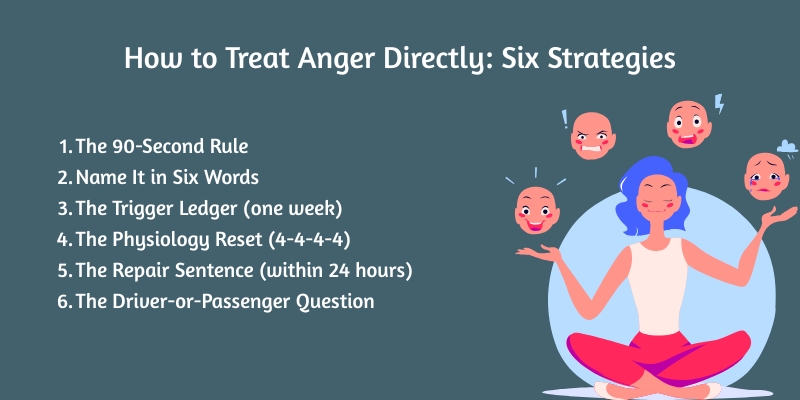
Now let’s get practical. These target the anger itself, not some assumed cause underneath it.
1. The 90-Second Rule
The physical surge of anger (the heat, the pounding heart) peaks and begins to fade in about 90 seconds if you don’t feed it. The story you tell keeps it alive. So don’t tell the story yet. “Give it 90 seconds before you give it words.”
2. Name It in Six Words
Putting a feeling into words calms the alarm part of your brain. Keep it short. “I’m angry because I feel disrespected.” Six words or fewer. Naming it starts to tame it.
3. The Trigger Ledger (one week)
For seven days, log every anger spike: the time, the trigger, the intensity from 1 to 10, and what you did. One week of data shows you your pattern. And patterns can be changed once you can finally see them.
4. The Physiology Reset (4-4-4-4)
Box breathing: in for 4, hold for 4, out for 4, hold for 4. Three rounds. This isn’t fluff; slow breathing is how you press the brake pedal your thinking brain needs to catch up.
5. The Repair Sentence (within 24 hours)
Within 24 hours, use three parts: behavior, impact, change. “When I raised my voice, it scared you. That’s on me. Here’s what I’ll do differently next time.”
6. The Driver-or-Passenger Question
Before you blame a deeper cause, ask one question: “Is anger the driver here, or the passenger?” If it shows up first, loudest, and out of proportion; it’s driving. Treat the driver.
If anger is the root, this is the root work
These strategies work. Use them today.
But here is the deepest truth. If your anger is primary, these tools are not a warm-up for the “real” treatment somewhere else. They are the real treatment. Anger management is not the consolation prize for people who can’t reach some deeper root. When anger is the root, structured anger management is the root work. It’s a portable skill set you carry into every room of your life.
That is exactly what the anger management courses at MasteringAnger.com are built to do: treat the anger directly, step by step. They were developed by Dr. Carlos Todd, PhD, LCMHC, a licensed counselor with over 20 years of experience. It is court-accepted. It is evidence-based. It is trusted by thousands of adults. Start Today!
But what if your anger really is secondary?
Sometimes the iceberg is right, and honesty matters here. If your anger lifts when your sleep improves, or fades once a depression is treated, or only appeared after a loss; it may be secondary. Knowing the difference between frustration and anger, or between anger and resentment, helps you tell them apart. Grief-anger, for instance, is a stage, not a disorder.
Both things can be true at once: you can have a primary anger pattern and a depression feeding it. The Treatment Audit tells you which is which. If a deeper cause is genuinely driving it, treat that too.
When to seek professional help
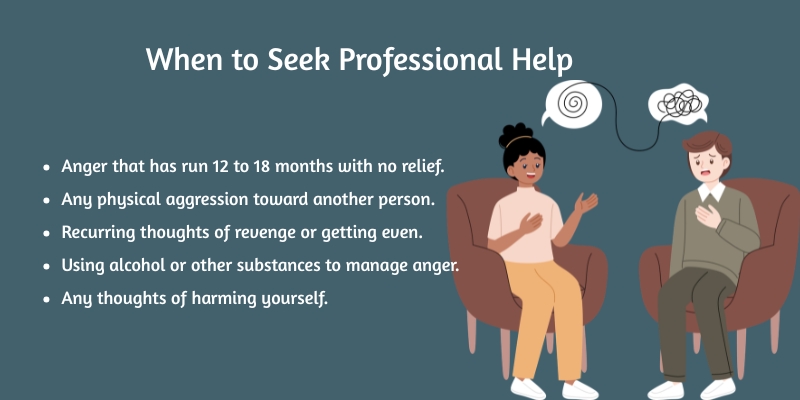
Some signs mean you need a licensed professional; not a course, and not later. Now:
- Anger that has run 12 to 18 months with no relief.
- Any physical aggression toward another person.
- Recurring thoughts of revenge or getting even.
- Using alcohol or other substances to manage the anger.
- Any thoughts of harming yourself.
If any of these fit (especially thoughts of self-harm) please talk to a licensed therapist. In the U.S., you can call or text 988 any time to reach the Suicide and Crisis Lifeline. There is no shame in it, and a course is never a substitute for a crisis line or a clinician.
The therapy landscape is real and it helps: CBT retrains the thoughts that fuel anger, DBT builds distress tolerance, and clinical care exists for intermittent explosive disorder. Our course is an accessible, structured first step for people who aren’t ready for therapy yet; or extra support alongside it. It is court-accepted, so if a judge has ordered anger management, our course qualifies.
You can also read the full picture of anger issues if you want a wider view first.
Frequently asked questions
Anger by itself is not classified as a mental illness. It is a normal human emotion. However, when anger becomes frequent, disproportionate, and difficult to control, it can point to a diagnosable condition such as intermittent explosive disorder, or it can appear as a symptom of depression, anxiety, PTSD, or other mental health conditions. Intermittent explosive disorder, or IED, is a recognized mental health diagnosis marked by repeated, impulsive outbursts of anger or aggression that are far more intense than the situation warrants. It typically begins in adolescence and can persist into adulthood without treatment. Yes. Anger management courses are designed for a wide range of situations, from everyday stress and communication breakdowns to more serious, clinically diagnosed anger disorders. You do not need a diagnosis to benefit from learning better emotional regulation skills. If your anger is damaging relationships, affecting your work or legal standing, producing intense guilt afterward, or accompanied by physical symptoms like a racing heart, it is time to consult a licensed mental health professional. A proper evaluation can determine whether an underlying condition is driving the pattern.Is anger considered a mental illness on its own?
What is intermittent explosive disorder?
Can anger management help even if I do not have a formal diagnosis?
How do I know if my anger needs professional help rather than self management?
You are not broken
Let me be very clear. You are not broken. You are not a bad person. Your anger is a signal, not a sentence; and sometimes it isn’t even a signal of something else. Sometimes it is the thing itself, waiting to be treated on its own terms.
The pattern can be interrupted. The alarm can be retrained. The response can be slowed.
For years, maybe everyone treated the smoke and ignored the fire. Now you know where the fire is. And if you’ve been asking yourself, “Is anger a mental health condition?”; the answer is that it can be, especially when it shows up as a primary, self-sustaining pattern rather than a symptom of something else. When that’s the case, treating the anger directly isn’t a shortcut; it’s the actual solution.
Ready to stop resetting the warning light and start treating the anger itself?
The anger management course at MasteringAnger.com was developed by Dr. Carlos Todd, PhD, LCMHC, a licensed counselor with over 20 years of experience. It’s court-accepted, evidence-based, and trusted by thousands of adults. Start your journey today.
Dr. Carlos Todd, PhD, LCMHC is a Licensed Clinical Mental Health Counselor, nationally recognized anger management and conflict resolution specialist, and founder of MasteringAnger.com and Conflict Coaching and Consulting Inc. With over 20 years of clinical experience, Dr. Todd has developed evidence‑based anger management programs used by individuals, couples, corporations, law enforcement agencies, and healthcare organizations across the United States. He holds a PhD with a specialization in conflict management intervention and is certified in anger management. His proprietary workbook and course curriculum have helped thousands of adults build lasting emotional regulation skills. MasteringAnger.com has been in continuous operation since 2009, offering court‑accepted, clinician‑designed online anger management courses ranging from 4 to 52 hours.