 English
 Spanish

Anger Management for Employees: Compliance and Growth

Missed deadlines, criticism from coworkers, or feeling undervalued can turn a regular workday into a challenge for any employee. Uncontrolled anger creates tension and risks disciplinary action, but managing it is more than just compliance. Proper anger management means learning to recognize, control, and express anger constructively, protecting your relationships and career while meeting American workplace standards and legal requirements.
Table of Contents
- Defining Anger Management In The Workplace
- Types Of Training And Certification Requirements
- How Employer-Mandated Programs Work
- Legal And HR Compliance Issues For Employees
- Common Pitfalls And Employee Responsibilities
Key Takeaways
| Point | Details |
|---|---|
| Understand Anger Management | It involves recognizing, controlling, and constructively expressing anger to prevent harm to relationships and productivity. |
| Three Pillars of Successful Management | Trigger recognition, response control, and effective communication are essential skills for managing anger in the workplace. |
| Employer-Mandated Training | Completing mandated anger management training enhances professional growth and legal compliance while ensuring safety in the workplace. |
| Engagement is Crucial | Active participation and honest self-reflection during training are necessary for developing effective anger management skills that can be applied long-term. |
Defining Anger Management in the Workplace
Anger is a normal human emotion. It ranges from mild irritation to intense rage, triggered by workplace situations like missed deadlines, unfair treatment, or communication breakdowns. The key difference between healthy anger and workplace problems is how you express it.
Anger management in the workplace isn’t about eliminating anger. It’s about learning to recognize, control, and express anger constructively so it doesn’t damage relationships, productivity, or your career.
What Anger Management Actually Means
Anger management involves understanding three core components of workplace anger:
- Physical reactions: Your body’s fight-or-flight response (elevated heart rate, tension, adrenaline)
- Cognitive experiences: How you perceive situations (feeling treated unfairly, disrespected, or undervalued)
- Behavioral expressions: How you respond (what you say, your tone, body language, or actions)
When you’re mandated to complete anger management training for employees, the goal is learning to manage all three components simultaneously.
Why This Matters in Your Workplace
Uncontrolled anger costs organizations millions annually. It leads to damaged team relationships, lower productivity, increased absenteeism, and potential legal liability. For you personally, unmanaged anger can result in disciplinary action, missed promotions, or job loss.
Proper anger management means learning to express your frustration assertively without aggression or suppression. You voice your concerns clearly while respecting others and maintaining professional standards.
The Three Pillars of Workplace Anger Management
Effective anger management rests on three foundational skills:
- Trigger recognition: Identifying what specifically sets you off (being interrupted, deadline pressure, feedback criticism)
- Response control: Managing your physical reactions and choosing constructive responses instead of reactive ones
- Communication skills: Expressing legitimate concerns in ways that resolve conflicts rather than escalate them
Think of it like a smoke detector. Your anger is the alarm. Learning anger management teaches you to acknowledge the alarm, investigate the cause, and respond appropriately instead of panicking or ignoring it.
Anger management isn’t about becoming emotionless or passive—it’s about channeling legitimate workplace frustrations into productive conversations that improve working conditions and relationships.
How This Connects to Compliance
When your employer mandates anger management training, they’re investing in both your professional growth and workplace safety. Court-accepted programs measure your progress through assessments that identify your specific triggers and risk factors, ensuring the training matches your actual needs.
Pro tip: Start by keeping a brief log of situations that trigger your anger—specific times, people involved, and what you felt. This data helps you identify genuine patterns that training directly addresses.
Types of Training and Certification Requirements
Anger management training programs come in different lengths and intensities. Your employer or court mandate determines which type you’ll complete. The right program matches your specific situation and risk level.
Most workplace anger management training uses cognitive-behavioral therapy (CBT) principles. This approach teaches you to recognize thought patterns that trigger anger, then replace them with healthier responses. Programs typically span multiple sessions, building skills progressively.

Understanding Course Length Options
Training programs vary significantly in duration. Shorter programs work for first-time issues or mild anger concerns, while longer programs address deeper patterns or legal mandates.
Common training durations include:
- 4-8 hours: Introductory programs for initial workplace incidents or awareness building
- 12-16 hours: Standard court-accepted programs balancing compliance and skill development
- 24-36 hours: Intermediate programs for repeated incidents or moderate risk profiles
- 52 hours: Comprehensive programs for serious incidents or complex anger patterns
Your specific course length depends on assessment results that measure your anger intensity and impulse-control risks. This ensures you’re not under-trained or over-trained for your actual needs.
To help clarify how different anger management program lengths serve various needs, here’s a summary table:
| Training Duration | Typical Use Case | Assessment Focus |
|---|---|---|
| 4-8 hours | First minor incident | Awareness, early signs |
| 12-16 hours | Standard workplace or legal compliance | Skill development, impulse control |
| 24-36 hours | Repeat incidents, moderate risk | Pattern change, advanced control |
| 52 hours | Serious, ongoing anger issues | Deep behavior change, high risk |
What Court-Accepted Certification Means
Court-accepted certification means the program meets legal standards for compliance documentation. When you complete training, you receive a certificate that courts, employers, probation officers, and attorneys can independently verify.
Legitimate providers include:
- Provider credentials (licensed counselor or clinician name)
- Company EIN and tax identification
- Course hours completed
- Assessment results basis
- Contact information for verification
This documentation protects you legally and proves to your employer or court that you completed accredited training, not generic online courses.
The Role of Assessment in Training Selection
Before starting any program, you’ll complete an anger assessment. This evaluates your triggers, physical responses, and behavioral patterns. Evidence-based anger management training relies on these assessments to match you with the right program length.
Assessments measure:
- Frequency and intensity of anger episodes
- Your ability to control impulses
- How anger affects your job performance
- Risk level for future incidents
The assessment isn’t punitive—it’s a diagnostic tool ensuring your training actually addresses your specific challenges, not generic anger issues.
Programs grounded in research, like those using CBT frameworks, produce measurable changes in how you recognize triggers and respond to frustration. You’re not just completing compliance hours; you’re developing skills with proven effectiveness.
Certification Verification Process
After completion, your certificate includes verifiable details. Employers and courts can contact the training provider to confirm you actually completed the program and the hours reported are accurate.
This transparency means your certification has real value. It proves genuine participation, not a shortcut.
Pro tip: Before enrolling, ask the training provider for sample certificates and verification procedures. Legitimate programs gladly provide this information, protecting both your compliance and their professional reputation.
How Employer-Mandated Programs Work
When your employer mandates anger management training, they’re following a structured process designed to address workplace anger issues while protecting everyone involved. Understanding how this works helps you navigate it confidently.
Your employer doesn’t randomly assign training length. Instead, they work with HR and qualified anger management providers to match your specific situation with an appropriate program. This balances legal compliance, organizational safety, and your professional growth.
The Initial Referral Process
Your employer initiates the mandate when a workplace incident occurs or behavioral concerns arise. This could follow a conflict with a coworker, an outburst in a meeting, or a pattern of tension affecting team dynamics.
Your HR department then:
- Documents the incident or concern triggering the mandate
- Notifies you of the requirement and deadline
- Provides information about approved training providers
- Explains what completion means for your employment status
You’re typically given a specific timeframe to complete training, usually 30-90 days depending on program length.
Assessment and Program Matching
Once enrolled, you’ll complete an anger assessment before training begins. This isn’t punishment—it’s diagnostic. The assessment identifies your specific anger triggers, how intensely you react, and your impulse-control capacity.
Based on assessment results, the provider recommends a program length. A first-time incident might require 8-12 hours, while repeated concerns could require 24-36 hours or longer.
Training Components You’ll Experience
Employer-mandated programs include educational and practical elements working together. Understanding these components helps you engage meaningfully rather than just completing hours.
Typical program components include:
- Self-awareness sessions: Identifying your personal anger triggers and patterns
- Physiological management: Learning to recognize and control your body’s stress response
- Cognitive restructuring: Replacing anger-fueling thoughts with realistic perspectives
- Communication skills: Expressing concerns assertively without aggression
- Conflict resolution strategies: Turning frustration into productive conversations
Employer-mandated programs balance organizational safety with your development. They aim to prevent future incidents while building skills you’ll use throughout your career.
Follow-Up and Verification
After completing training, your provider sends documentation to your employer and HR department. This includes course hours, assessment results, and completion dates.
Your employer may require a follow-up conversation with HR to discuss what you learned and how you’ll apply it. Some organizations also monitor behavioral changes over the following months.
Why This Matters for Your Career
Completing mandated training protects your employment and demonstrates your commitment to professional behavior. Many organizations view successful completion as a turning point—proof you’re taking workplace conduct seriously.
Pro tip: Treat the training as genuine skill-building, not just compliance checking. Ask questions, actively participate, and take notes on strategies you’ll actually use. This transforms a mandate into professional growth that benefits your career long-term.
Legal and HR Compliance Issues for Employees
When your employer mandates anger management training, legal protections apply to you throughout the process. Understanding these protections helps you navigate compliance confidently and know your rights.
Your employer must follow strict laws governing workplace behavior, discrimination, and retaliation. These laws protect you while they require anger management participation. The balance matters for both sides.
Your Rights During the Mandate
You have significant legal protections when participating in employer-mandated anger management. Federal law prevents your employer from retaliating against you for completing the program or disclosing mental health information.
Key protections include:
- Non-retaliation: Your employer cannot fire, demote, or harass you for participating in anger management
- Confidentiality: Your training records and assessment results remain private between you and the provider
- Reasonable accommodations: If your anger relates to a disability, your employer must provide accommodations
- Non-discrimination: Your employer cannot treat you differently based on protected characteristics while requiring training
These protections come from federal laws including Title VII, the Americans with Disabilities Act, and OSHA workplace safety standards.
To provide a quick reference to your rights during mandated anger management, see the table below:
| Legal Right | What It Guarantees | Governing Law or Standard |
|---|---|---|
| Non-retaliation | No firing or harassment for compliance | Title VII, ADA |
| Confidentiality | Private records, no coworker sharing | HIPAA-like, ADA |
| Reasonable accommodation | Flexible schedule, role modifications | ADA, OSHA |
| Non-discrimination | Equal treatment regardless of background | Federal anti-discrimination law |
Mental Health Condition Protections
If your anger stems from depression, PTSD, anxiety, or other mental health conditions, legal protections prevent workplace discrimination under the Americans with Disabilities Act.
Your employer must:
- Provide reasonable accommodations related to your condition
- Allow you to participate in anger management without penalty
- Keep your mental health information confidential
- Not disclose your condition to coworkers or clients
If your condition requires specific accommodations during training, communicate this to your HR department.
HR Compliance and Privacy
Your HR department must maintain strict confidentiality about your anger management participation. Assessment results, course completion records, and program details cannot be shared with coworkers or used against you.
Your training provider:
- Cannot disclose details to anyone except your employer’s HR department
- Must follow HIPAA-like confidentiality standards
- Issues certificates verifying completion, not specific behavioral details
- Maintains secure records protected by state and federal privacy laws
Your anger management training is protected health information. Your employer cannot use participation against you, share details with coworkers, or retaliate based on initial incident that triggered the mandate.
What “Reasonable Accommodation” Means
Reasonable accommodation means your employer adjusts work conditions to help you succeed in anger management while maintaining workplace safety. This might include schedule flexibility for training sessions, temporary role adjustments, or modified work assignments.
If you need accommodations, request them in writing through HR with specific details about what would help.
Documentation and Legal Protection
Keep all training-related documentation for your records. This includes enrollment confirmations, completion certificates, and any HR communications about the mandate.
This documentation protects you if questions arise later about compliance or completion. It proves you fulfilled the requirement and when.
Pro tip: Request written confirmation from your employer when the mandate concludes and your compliance obligation is satisfied. Get this in writing so there’s no confusion about whether future behavioral issues relate to your original mandate or new concerns.
Common Pitfalls and Employee Responsibilities
Many employees approach mandated anger management with the wrong mindset, which undermines their progress and wastes the opportunity to build lasting skills. Recognizing common pitfalls helps you avoid them and take real responsibility for change.
Your success depends on active participation, honest self-reflection, and genuine commitment to applying what you learn. This isn’t something your employer or trainer can do for you.
The Suppression Trap
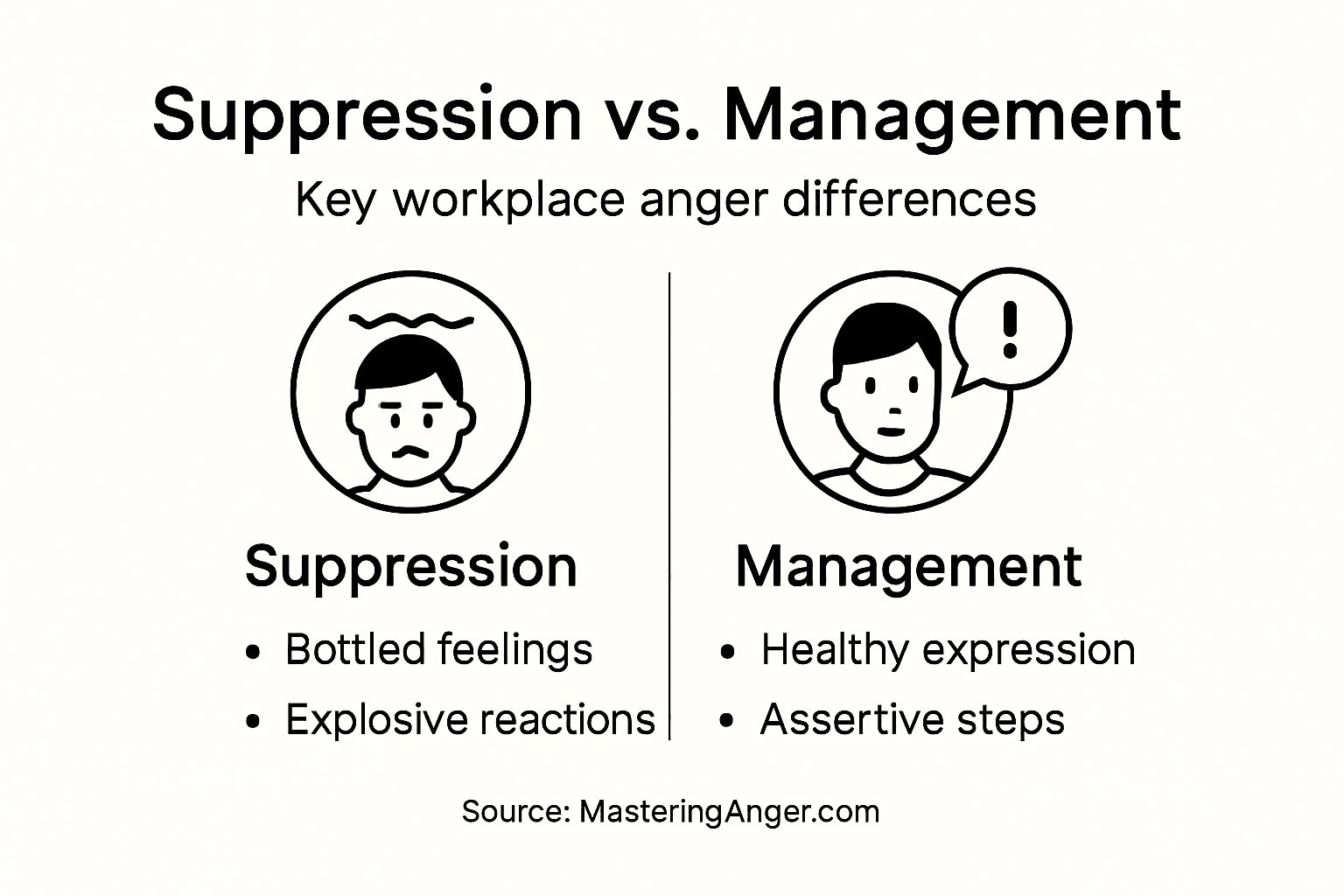
One critical mistake is bottling up anger instead of addressing it. Suppression feels like control, but it actually builds resentment that explodes later, often unexpectedly and intensely.
Suppression vs. management are completely different. Suppression means ignoring anger signals until they overflow. Management means acknowledging anger, understanding why you feel it, and responding constructively.
When you encounter frustration during training, resist the urge to simply swallow it. Instead, talk through it, write about it, or discuss it with your trainer.
Denial and Blame-Shifting
Another common pitfall is denying your anger problem or blaming others for workplace conflicts. You might think the incident wasn’t your fault, everyone else overreacted, or your anger was justified.
This mindset stops your growth immediately. Taking ownership means:
- Acknowledging your anger responses, regardless of what triggered them
- Recognizing how your behavior affected others and the workplace
- Accepting that you alone control your responses
- Committing to different choices going forward
Blaming circumstances or people keeps you stuck. Responsibility opens the door to change.
Your Core Responsibilities in Training
You’re responsible for several critical elements of your anger management success:
- Attendance and participation: Show up on time for all sessions and actively engage, not just passively listen
- Honest self-reflection: Identify your real triggers and patterns, even uncomfortable ones
- Skill application: Practice techniques outside training and use them when real frustration arises
- Communication: Ask questions, share struggles, and admit when something doesn’t work for you
- Behavioral follow-through: Apply what you learn to actual workplace situations
Your trainer provides tools. You build the skills through conscious practice.
Common Avoidance Tactics
Some employees try to just “get through” training without genuine engagement. This approach fails consistently.
Watch out for:
- Rushing through assignments without real thought
- Staying silent in group discussions instead of sharing struggles
- Skipping practice exercises or completing them halfheartedly
- Attending sessions but not thinking about application
- Assuming one training session fixed everything
Your anger management success depends entirely on the effort you invest during and after training. No program can change behavior without your active commitment and practice.
Taking Ownership of Triggers
Trigger recognition is your responsibility. You must learn what specifically sets you off, not in general terms but in your specific workplace situations.
Instead of “people disrespecting me,” identify “when my manager interrupts during presentations” or “when coworkers take credit for my work.” Specific triggers lead to specific strategies.
Keep a trigger journal during training. Document situations, what you felt, and how you responded. This creates the data you need for real progress.
Following Through After Completion
The training doesn’t end when you receive your certificate. Your responsibility extends weeks and months beyond the final session.
After completion, you must:
- Actively use techniques when workplace frustration arises
- Reach out to HR or your trainer if new situations trigger old patterns
- Monitor your behavioral changes and adjust as needed
- Demonstrate sustained improvement to your employer
This follow-through proves the training wasn’t just compliance theater.
Pro tip: Create a “trigger response plan” listing your top three workplace triggers and exactly how you’ll respond differently. Review it weekly for the first month after training. This transforms training concepts into automatic, healthier habits.
Take Control of Your Workplace Anger with Proven, Court-Accepted Training
Unmanaged anger at work leads to serious consequences like damaged relationships and job risks. If your employer has mandated anger management training or you want to grow professionally, understanding your triggers and learning constructive responses is essential. Our evidence-based programs use clinically proven methods such as cognitive-behavioral therapy to help you recognize physical reactions and control behavioral expressions of anger.
MasteringAnger.com offers flexible online courses ranging from 4 to 52 hours designed specifically for employees facing workplace challenges and compliance requirements. Backed by licensed mental health professionals and accepted by courts, employers, and attorneys, our programs include personalized assessments that match you with the right course length so you get only what you actually need. Start building communication skills and impulse-control strategies today to protect your career and improve work relationships. Explore our anger management classes and get certified with trusted documentation that proves your commitment. Take the first step now by visiting MasteringAnger.com and empower yourself to transform frustration into professional growth.
Frequently Asked Questions
What is anger management in the workplace?
Anger management in the workplace involves recognizing, controlling, and expressing anger constructively to maintain relationships and productivity, rather than eliminating the emotion altogether.
What are the key components of anger management training?
Anger management training focuses on three key components: physical reactions to anger, cognitive experiences that shape your perception of situations, and behavioral expressions of anger, including how you communicate and respond.
How can I identify my anger triggers?
You can identify your anger triggers by keeping a journal of specific situations that provoke your anger, noting the times, people involved, and your emotional responses. This helps in recognizing patterns and developing coping strategies.
What should I expect from employer-mandated anger management training?
Employer-mandated anger management training typically includes assessments to identify triggers, learning effective communication skills, and strategies for conflict resolution. It aims at ensuring workplace safety while promoting your professional growth.
Recommended
- Anger Management for Professionals: Compliance Solutions
- Anger Management Training for Employees | Mastering Anger
- Role of Anger Management Classes for Legal Compliance
- Anger Management Curriculum Explained: Structure and Impact
- 7 Essential Work Injury Compensation Tips for UK Employees
Dr. Carlos Todd PhD LCMHC specializes in anger management, family conflict resolution, marital and premarital conflict resolution. His extensive knowledge in the field of anger management may enable you to use his tested methods to deal with your anger issues.



Responses